
SMT equipment FAQ for EMS and OEM buyers
Practical answers for procurement, engineering and production teams comparing reflow ovens, wave soldering machines, PCB handling equipment and full SMT line configuration.
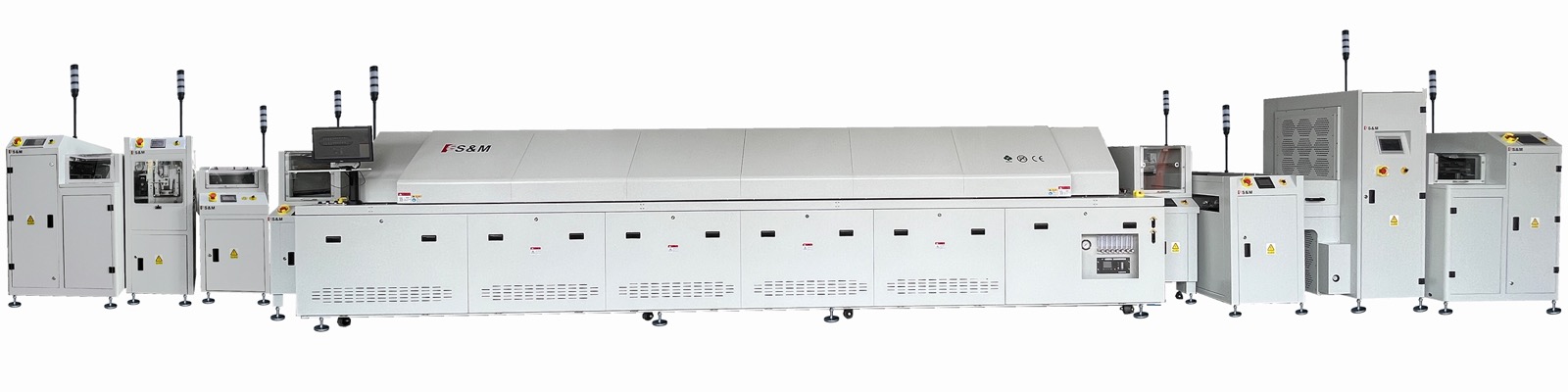
Buying and supplier questions
Why choose S&M instead of an imported brand?
S&M targets factories that need stable industrial equipment but cannot justify imported-brand pricing for every expansion line.
Can S&M supply more than one machine?
Yes. S&M builds soldering equipment and PCB handling equipment, so the line can be matched around board size, transfer height and takt time.
What information is needed for quotation?
Board size, product type, target UPH, process requirement, factory layout and destination country are enough for a first configuration discussion.
Reflow oven questions
Air, nitrogen or vacuum reflow?
Use air reflow for standard SMT work, nitrogen when oxidation control matters, and vacuum when void reduction is a key reliability target.
How many zones do I need?
Choose by board size, thermal mass, lead-free process window and throughput. More zones give more profile control but should match the real product.
Can reflow ovens fit different board widths?
Yes, but the required PCB width range must be confirmed before selecting the model and conveyor configuration.
Wave soldering and curing questions
When do I need wave soldering?
Use wave soldering when through-hole connectors or mixed-technology boards cannot be converted to SMT-only design.
When is selective soldering better?
Selective soldering fits boards with only a few through-hole points or sensitive SMT areas that should not pass through a full wave.
When do I need a curing oven?
Curing ovens are used for adhesive, coating, thermal curing or UV curing steps depending on the product process.
PCB handling and line rhythm questions
Why not load boards manually?
Manual loading may work for small batches, but it creates rhythm variation, handling risk and operator dependency as volume grows.
When should I add a buffer?
Add buffers when inspection, reflow, wave soldering or manual checks can stop one station and block the whole line.
How do conveyors affect yield?
Good transfer support reduces board jams, scratches and handling errors, especially for large panels or high-mix lines.
Delivery, installation and support questions
| Question | Practical answer |
|---|---|
| Can you support overseas projects? | Yes. Share destination, project schedule and line layout so the team can confirm shipping and support details. |
| Can equipment be customized? | Many models support configuration around board width, transfer height, nitrogen, vacuum, track type or line layout. |
| How should I compare suppliers? | Compare based on process fit, line rhythm, verified specs, after-sales response and total cost, not only machine price. |
Still not sure which equipment fits?
Send your board size, process and target output. We will suggest a practical equipment path for your SMT line.
If you already have a line layout or board photo, mention it in the requirement field.