
Wave soldering equipment for EMS and OEM factories
Wave Soldering Machines for Through-Hole and Mixed PCB Assembly
S&M wave soldering machines are built for factories that need stable through-hole soldering, lead-free process control, and practical line integration. The range covers in-line wave soldering, nitrogen wave soldering, off-line wave soldering, off-line nitrogen wave soldering, and selective soldering.
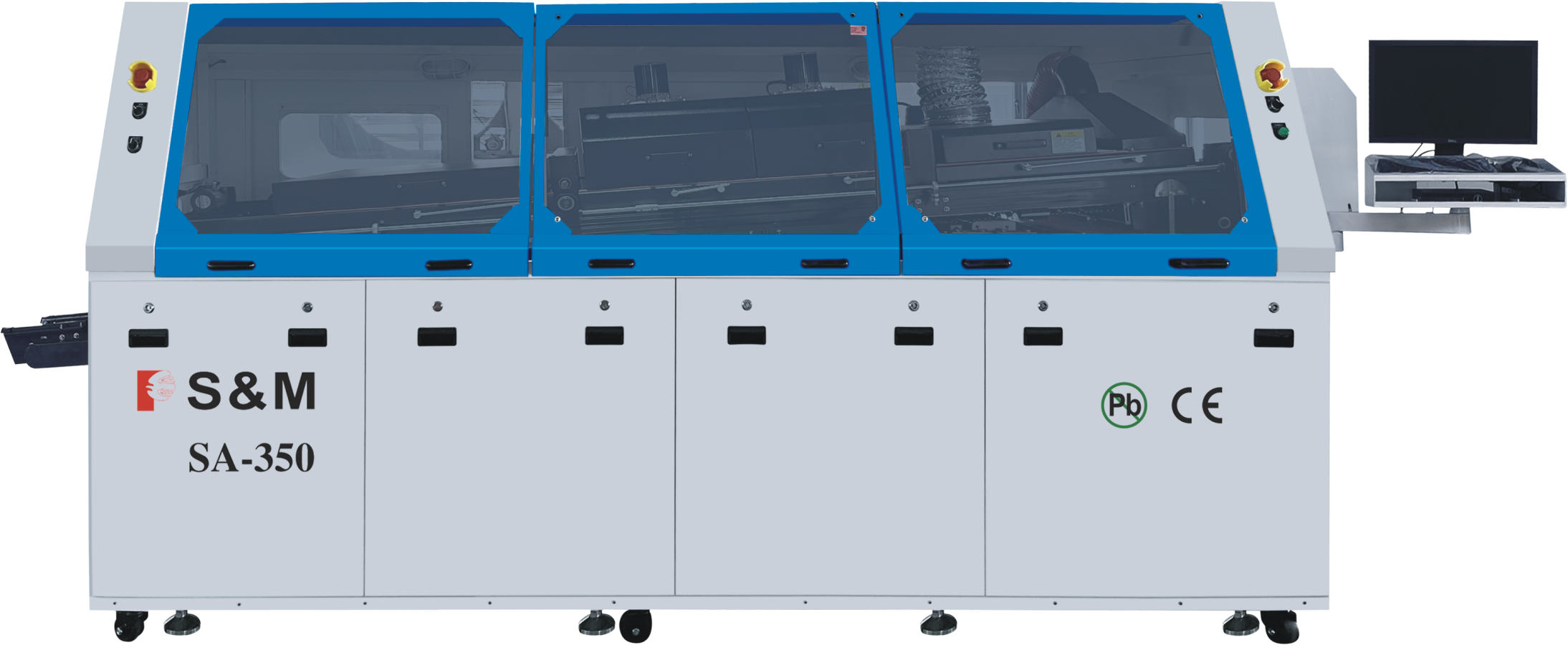
Real S&M SA series wave soldering equipment, used for THT and mixed PCB assembly.
What Is a Wave Soldering Machine?
A wave soldering machine solders through-hole components by passing a PCB over a controlled wave of molten solder. It is commonly used after component insertion in DIP/THT lines or mixed SMT + through-hole production.
A typical process includes fluxing, preheating, solder wave contact, and cooling. The goal is stable solder joints with controlled solder bridging, insufficient solder, oxidation, and thermal stress.
What Is Wave Soldering Used For?
Through-Hole Components
For connectors, transformers, large capacitors, relays, terminals, and other THT components that cannot be fully processed by reflow soldering.
Mixed SMT + THT Boards
For PCB assemblies that combine reflowed SMT components with inserted through-hole components in a later soldering step.
Industrial and Power Electronics
Common in power supplies, industrial control boards, automotive electronics, LED electronics, and other products with heavier components.
Real product groups
Different Types of S&M Wave Soldering Machines
Only real S&M product groups are listed here. No invented SEO categories.
In-Line Wave
SA-350 / SA-450 / SA-610. For standard DIP/THT and mixed-board production.
In-Line Nitrogen
SA-350N / SA-450N. For lead-free soldering with reduced oxidation and dross.
Off-Line Wave
SAT-350 / SAT-450 / SAT-610. For flexible batch production outside the main line.
Off-Line Nitrogen
SAT-350N / SAT-450N / SAT-610N. Off-line flexibility with nitrogen process support.
Selective Soldering
SM-LI / SM-LII. For targeted joints on complex mixed SMT + THT boards.
Full machine view for standard wave soldering production.
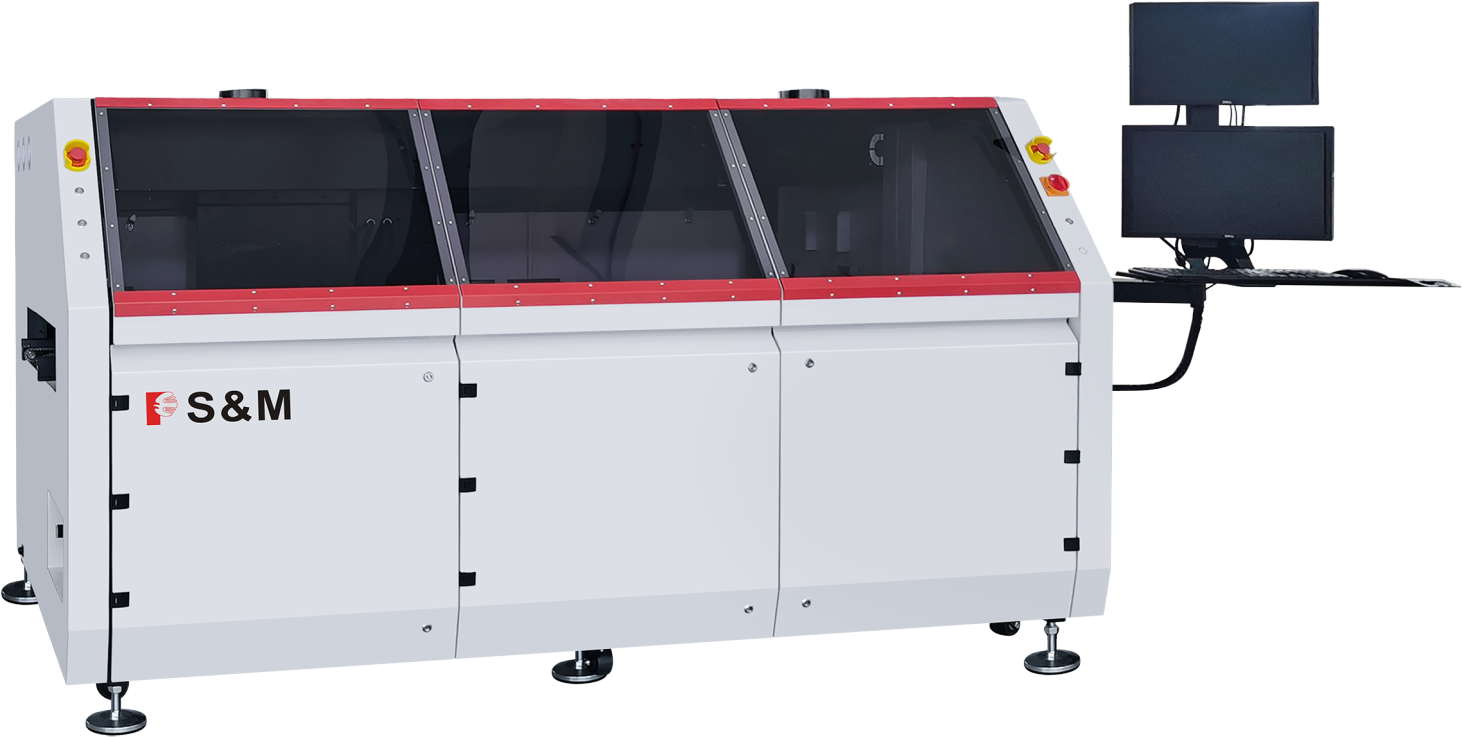
Selective soldering equipment for targeted through-hole joints.
Wave Soldering vs Selective Soldering
| Requirement | Wave Soldering | Selective Soldering |
|---|---|---|
| Best for | Many through-hole joints across the board | Specific through-hole joints only |
| Production volume | Medium to high volume | High-mix, lower to medium volume |
| Board risk | Best when the board is designed for wave process | Better for boards with sensitive areas or bottom-side SMT |
| Typical S&M models | SA / SA-N / SAT / SAT-N series | SM-LI / SM-LII |
How to Choose a Wave Soldering Machine
PCB Size
- Maximum PCB width
- PCB length and thickness
- Board weight
- Component height
Process Requirement
- Lead-free or leaded process
- Nitrogen requirement
- Full wave or selective soldering
- Flux and solder alloy requirement
Production Layout
- In-line or off-line production
- Target UPH
- Available floor space
- Upstream/downstream equipment
Selection Table
| Customer Requirement | Recommended S&M Product Group | Model Options |
|---|---|---|
| Standard in-line through-hole production | In-line wave soldering | SA-350 / SA-450 / SA-610 |
| Lead-free production with oxidation control | In-line nitrogen wave soldering | SA-350N / SA-450N |
| Flexible batch production outside the main line | Off-line wave soldering | SAT-350 / SAT-450 / SAT-610 |
| Off-line process with nitrogen support | Off-line nitrogen wave soldering | SAT-350N / SAT-450N / SAT-610N |
| Complex mixed boards or selected THT joints only | Selective wave soldering | SM-LI / SM-LII |
Model range
S&M Wave Soldering Models
Grouped by real product series and process type.
| Series | Models | Process / Best Fit | Model Links |
|---|---|---|---|
| SA | SA-350 / SA-450 / SA-610 | In-line wave soldering for 350 / 450 / 610 mm PCB width classes. | SA-350 · SA-450 · SA-610 |
| SA-N | SA-350N / SA-450N | In-line nitrogen wave soldering for lead-free process stability. | SA-350N · SA-450N |
| SAT | SAT-350 / SAT-450 / SAT-610 | Off-line wave soldering for flexible batch production. | SAT-350 · SAT-450 · SAT-610 |
| SAT-N | SAT-350N / SAT-450N / SAT-610N | Off-line nitrogen wave soldering for reduced oxidation and better soldering quality. | SAT-350N · SAT-450N · SAT-610N |
| SM-L | SM-LI / SM-LII | Selective soldering for targeted joints on complex mixed boards. | SM-LI · SM-LII |
Key Technical Data Confirmed From Product Pages
| Model Group | Confirmed Data | Notes |
|---|---|---|
| SA-350 / SA-450 / SA-610 | 350 / 450 / 610 mm PCB width options, wave soldering process, SMEMA compatible. | SA-610 product page lists reinforced transport for large boards. |
| SA-350N / SA-450N | Nitrogen wave soldering, ~70 kW total power, 3-phase 5-wire / 380V, conveyor speed 400-1800 mm/min, width range 50-350 mm or 50-450 mm. | Used when reduced dross and solder joint quality are important. |
| SAT series | Off-line wave soldering, ~70 kW total power, 3-phase 5-wire / 380V, 400-1800 mm/min conveyor speed, 500kg or 600kg solder pot capacity depending on model. | For flexible batch production independent of the main SMT line. |
| SAT-N series | Off-line nitrogen wave soldering, ~70 kW total power, nitrogen support, 400-1800 mm/min conveyor speed. | SAT-610N page lists 580kg solder pot capacity. |
| SM-LI | Selective soldering, single electromagnetic pump, 30 kW total power, inline or standalone option. | For targeted soldering where full-wave process is not suitable. |
| SM-LII | Selective soldering, dual electromagnetic pump, 2980(L) x 1910(W) x 1662(H), 30 kW, 1800kg, conveyor width 50-450 mm, max soldering area L460 x W460 mm. | For higher soldering workload and flexible selective soldering coverage. |
Exact configuration can change by order. For quotation, confirm PCB width, process type, nitrogen requirement, line direction, voltage, and destination country.
Where It Fits in the Production Line
Typical DIP or mixed assembly line:
For selective soldering:
Common Problems This Equipment Solves
- Manual soldering is too slow or inconsistent for production demand.
- Through-hole solder joints need better repeatability.
- Lead-free soldering creates more oxidation or dross than expected.
- Board width exceeds the capacity of a smaller soldering machine.
- Mixed SMT + THT boards need selective soldering instead of full-board wave contact.
- The soldering process needs to match loaders, unloaders, conveyors, buffers, and inspection steps.
Why Choose S&M for Wave Soldering Equipment?
S&M manufactures soldering equipment and PCB handling equipment in-house. That matters because a wave soldering machine must not only solder well. It must also match board width, line height, production speed, operator access, and upstream/downstream handling.
- Real model range covering in-line, nitrogen, off-line, off-line nitrogen, and selective soldering.
- PCB width options from 350 mm to 610 mm class production.
- Integration with PCB loaders, unloaders, conveyors, buffers, flux sprayers, and inspection steps.
- Configuration recommendation based on PCB size, UPH target, process type, floor space, and destination country.
- International-quality build standard with local pricing and full in-house production.
FAQ
What is a wave soldering machine used for?
It is used to solder through-hole components on PCB assemblies. It is common in DIP/THT and mixed SMT + through-hole production.
How do I choose between SA-350, SA-450, and SA-610?
The main factor is PCB width. SA-350 is for 350 mm class boards, SA-450 is for 450 mm class boards, and SA-610 is for wider 610 mm class production.
When should I choose nitrogen wave soldering?
Choose nitrogen when lead-free soldering quality, oxidation control, wetting stability, or dross reduction is important.
When is selective soldering better than full wave soldering?
Selective soldering is better when only selected through-hole joints need soldering, or when the PCB has sensitive areas or bottom-side SMT components that should not pass through a full wave process.
Can S&M configure the machine for my line layout?
Yes. Send PCB size, line direction, target UPH, floor space, upstream/downstream equipment, and destination country. S&M can recommend a practical configuration.
What information is needed for a quotation?
Send maximum PCB width, PCB length, board thickness, process type, lead-free or leaded requirement, nitrogen requirement, target UPH, line layout, and destination country.
Submit Your Wave Soldering Requirement Directly
Send your PCB size, board width, soldering process, target UPH and line layout. S&M will recommend a practical wave soldering or selective soldering configuration for your production line.
Submit Your Requirement Here
Fill in the form below. Tell us your PCB size, process requirement, target UPH and destination country. Our team will respond within 1 business day.