
Electronics Assembly Explained: Processes, Trends, and Industry Innovations
Electronics assembly is where the magic of modern manufacturing happens. You might not think about it as you’re scrolling on your phone or watching Netflix, but nearly every piece of tech in your life relies on this complex process. From smartphones to electric cars, electronics assembly ensures everything fits together perfectly.
Published: 24 April 2026
Reading Time: 12 minutes
Reviewer: NA, NA
Jace Liu is a seasoned expert in surface mount technology (SMT) and electronics manufacturing equipment with over 10 years of hands-on experience. As a dedicated contributor to innovation-driven industries, Jace specializes in helping manufacturers optimize their assembly processes for scalability and precision.
What Is Electronics Assembly and Why Does It Matter?
At its core, electronics assembly gives life to technology. It’s the process of putting together electronic components, like resistors, capacitors, and microchips, onto printed circuit boards (PCBs). These boards act as the brains of devices, coordinating everything from power flow to communication.
Imagine you’re building a big LEGO set. You need everything to click in just the right spots for it to work. Now picture that with tiny, microscopic pieces assembled at lightning speed. That’s electronics assembly in a nutshell; it’s all about precision.
Why Is Electronics Assembly So Important?
Electronics assembly plays a huge role in industries like healthcare, automotive, and aerospace. These sectors depend on reliable, scalable manufacturing to bring their innovations to life. Original Equipment Manufacturers (OEMs) and Electronics Manufacturing Services (EMS) businesses are at the heart of this process, leveraging advanced assembly technologies to stay efficient and competitive.
For example, think about the medical devices that monitor your heart rate or the sensors in electric vehicles controlling your braking system. The quality of electronics assembly directly affects the reliability of these products, making it critical for industries where precision matters most.
Advances and Trends in Electronics Assembly
Modern electronics assembly has transformed with cutting-edge technologies. Advanced automation, AI-powered data analytics, and robotics are driving precision, scalability, and speed to new heights.
Some highlights include:
- AI Integration: AI now handles real-time monitoring and inspection. It spots issues like defects before they become major problems, ensuring every product meets quality standards.
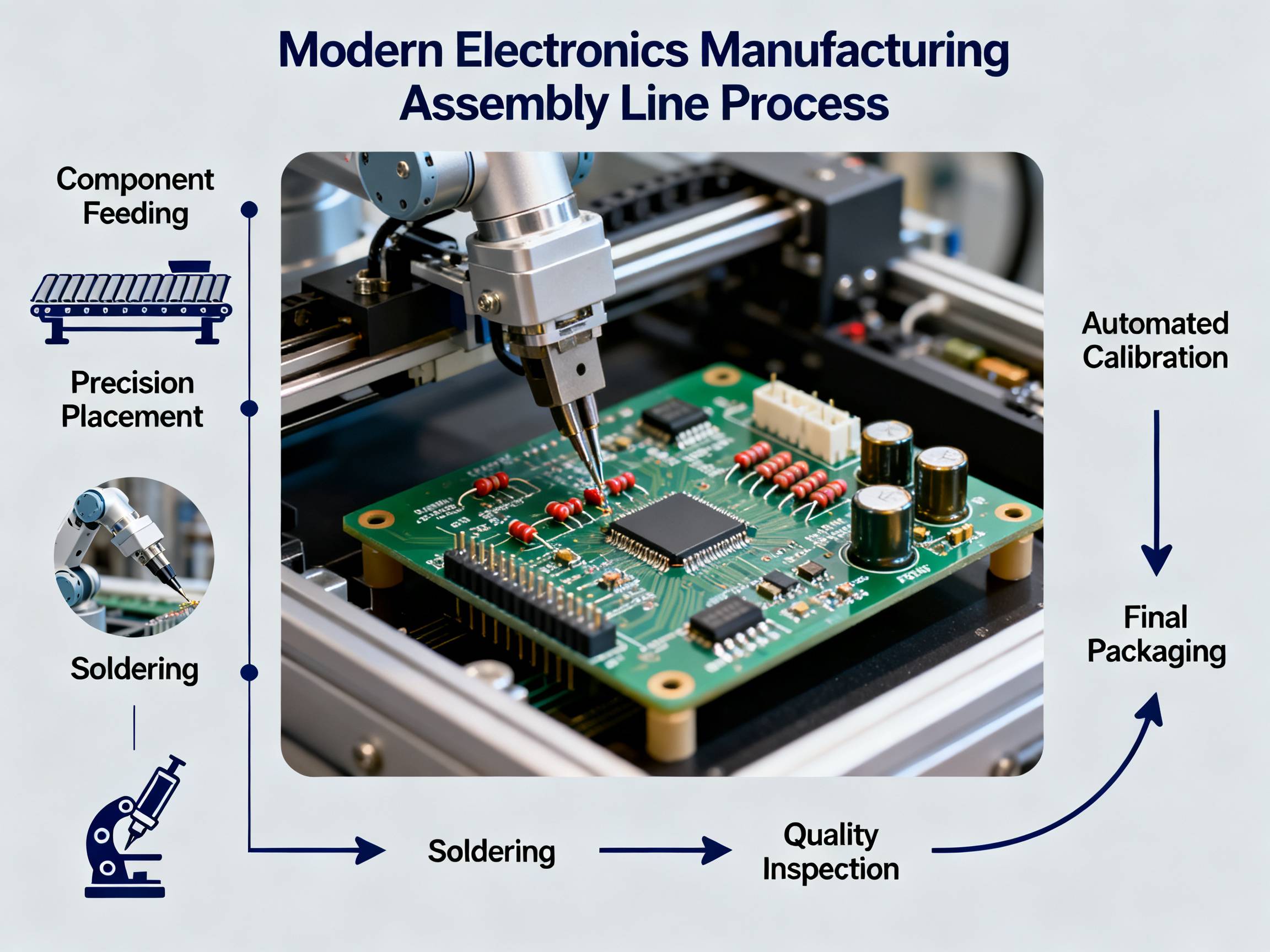
- Robotics for Miniaturization: Using robotics, manufacturers can assemble ultra-small components with incredible accuracy. This is crucial for wearables, IoT devices, and microelectronics.
- Switch to HDI and Mixed-Technology Boards: High-density interconnect (HDI) and mixed-technology boards allow complex designs with smaller footprints. These boards are ideal for high-performance devices packed into tight spaces.
- Sustainable Materials: From recyclable substrates to energy-saving equipment, sustainability is now part of the equation.
Expert Tip: Curious how manufacturers use AI in assembly lines? By integrating AI for real-time monitoring, they catch defects early and optimize production efficiency.
Core Processes in Electronics Assembly Lines
You might wonder, “What exactly happens on an electronics assembly line?” Here’s the flow:
- PCB Preparation: Boards are created and ready to house components.
- Component Procurement: Parts are sourced, sorted, and prepped.
- Solder Paste Deposition: This step applies a layer of paste to secure components.
- Component Placement: Robots place components like tiny LEGO pieces.
- Reflow Soldering: Using high-tech ovens, the paste melts, holding components in place.
- Inspection: Automated Optical Inspection (AOI) scans for flaws.
- Conformal Coating: Adds protective layers to withstand wear and tear.
- Functional Testing: Checks if a final product actually works.
- Packaging: Final step where products are boxed and prepped for shipment.
These steps rely on a mix of automation and human expertise to ensure the finished product works perfectly.
—### Surface Mount Technology and Essential Techniques
Surface Mount Technology, or SMT, is the backbone of modern electronics assembly. Unlike older through-hole methods, where components are inserted into drilled holes on a PCB, SMT involves directly mounting components onto the board’s surface. This technique is faster and allows for the use of smaller, more complex components.
Key SMT Processes: Reflow and Wave Soldering
Two critical processes in SMT drive much of the efficiency and precision of modern assembly:
-
Reflow Soldering: This process melts solder paste using a high-tech oven with controllable heating zones. Components stick securely as the paste heats up and cools down in a controlled environment. It’s ideal for finely detailed PCBs with thousands of components.
-
Wave Soldering: While a bit older, this method is still used in specific cases, especially with through-hole components. PCBs are passed over a wave of molten solder, which coats and connects components in one quick pass. This is perfect for circuits needing strong, reliable solder joints.
Both methods highlight how advanced assembly technology balances speed and durability.
Real-Time Monitoring for Seamless Operations
Troubleshooting and real-time monitoring are the unsung heroes of efficient electronics assembly. By integrating advanced AI in assembly lines, manufacturers can detect errors immediately. Small problems, like a misaligned component, can be fixed early, saving time and reducing waste. This continuous monitoring keeps production lines running smoothly and maintains high-quality standards.
For example, companies like Sun and Mountain (SMT) use precision reflow ovens equipped with analytics tools, allowing operators to track solder temperature consistency in real time. These tools reduce downtime and make sure production goals stay on track.

Real-time data not only catches problems but can also predict them, making processes smarter and more efficient. This kind of predictive maintenance is becoming a must-have in 2026 for scaling operations while staying competitive.