
SMT Manufacturing Explained: Standards, Processes, and Compliance
Published: 16 April 2026
Reading Time: 10 minutes
Reviewer: [To Be Added]
Surface Mount Technology (SMT) has quietly transformed the electronics industry. Walk into any modern factory; chances are you’ll see automated SMT equipment working tirelessly, placing thousands of tiny components onto printed circuit boards (PCBs) with pinpoint accuracy. The result? Lighter, faster, and more capable devices than we could have imagined even a decade ago. But what exactly is SMT, and what makes it a cornerstone of electronics manufacturing in 2026?
Jace Liu, a leading voice in electronics manufacturing, brings over 15 years of experience in SMT equipment design and implementation. As a frequent contributor to industry journals, Jace combines technical expertise with actionable insights to support advanced manufacturing solutions.
What is Surface Mount Technology (SMT)?
Surface Mount Technology, or SMT, is a manufacturing method used to attach electronic components directly to the surface of a PCB. Unlike Through-Hole Technology (THT), which requires drilling holes into the board, SMT components (called surface-mount devices or SMDs) are mounted flat onto the board.
Why does this matter? Well, skipping the drilling step allows manufacturers to shrink the size of PCBs, add more components, and boost production speed. SMT has been a game-changer for any industry that relies on compact, high-performance electronics.
SMT vs. Through-Hole: What’s the Difference?
SMT and Through-Hole Technology both have their place in manufacturing, but each serves different needs:
| SMT | Through-Hole Technology | |———————————–|————————————| | Faster assembly speeds | Slower assembly speeds | | Automated, highly precise | More manual labor required | | Compact, ideal for small devices | Larger, bulkier components | | May not be as durable for physical stress applications | Better for mechanical durability |
For example, while SMT dominates modern electronics (like smartphones and laptops), THT still sees use in industries like aerospace or automotive, where durability under stress takes top priority.
Key Advantages of SMT
- Scalability: SMT production lines can churn out thousands of PCBs daily with minimal human intervention. Automation is the name of the game here.
- Precision: Automated pick-and-place machines ensure every component lands exactly where it should, reducing defects.
- Efficiency: SMT minimizes wasted materials and energy, helping manufacturers keep costs down.
- Supports Miniaturization: Ever wondered how smartphones keep getting thinner? SMT is a big reason why.
Want proof? Products like Sun and Mountain’s automated SMT equipment are specifically designed to meet modern electronics manufacturing’s demands.

The SMT Assembly Process Explained
Now that we know what SMT is, let’s get into the nitty-gritty of how it works. The SMT assembly process is like a well-choreographed ballet. Each step must align perfectly with the next, and timing is everything.
Step 1: Applying Solder Paste
To start, the PCB is coated with solder paste. This paste is a mix of tiny metal balls and flux. It’s spread across the board using a stencil to ensure it hits just the right spots.
Step 2: Component Placement
Next up, the components are placed on the board. This is done using high-speed pick-and-place machines. These machines zip around, grabbing individual components and putting them exactly where they need to go. It’s fun to watch (and crucial for efficiency).
Step 3: Reflow Soldering
After placing the components, the board goes into a reflow oven. Picture a pizza oven but for circuit boards. The heat melts the solder paste, bonding the components to the board.
Challenges and Solutions
Each stage has its quirks. During solder paste application, the paste can smear if not evenly applied. Component placement requires precision; otherwise, stuff might end up in the wrong spots. And reflow soldering needs perfect heat settings. But fear not, advanced machinery tackles these issues head on.
How Automation Works
Modern assembly lines are mostly automated. Trust me, I’ve watched these lines in action. Automation makes everything smoother, minimizing errors and boosting reliability. Machines have become super smart, checking themselves as they go.
From Our Experience: Automating the SMT process significantly boosts scalability.
Sun and Mountain’s equipment shines here. Their machines coordinate seamlessly, making assembly lines less prone to hiccups.
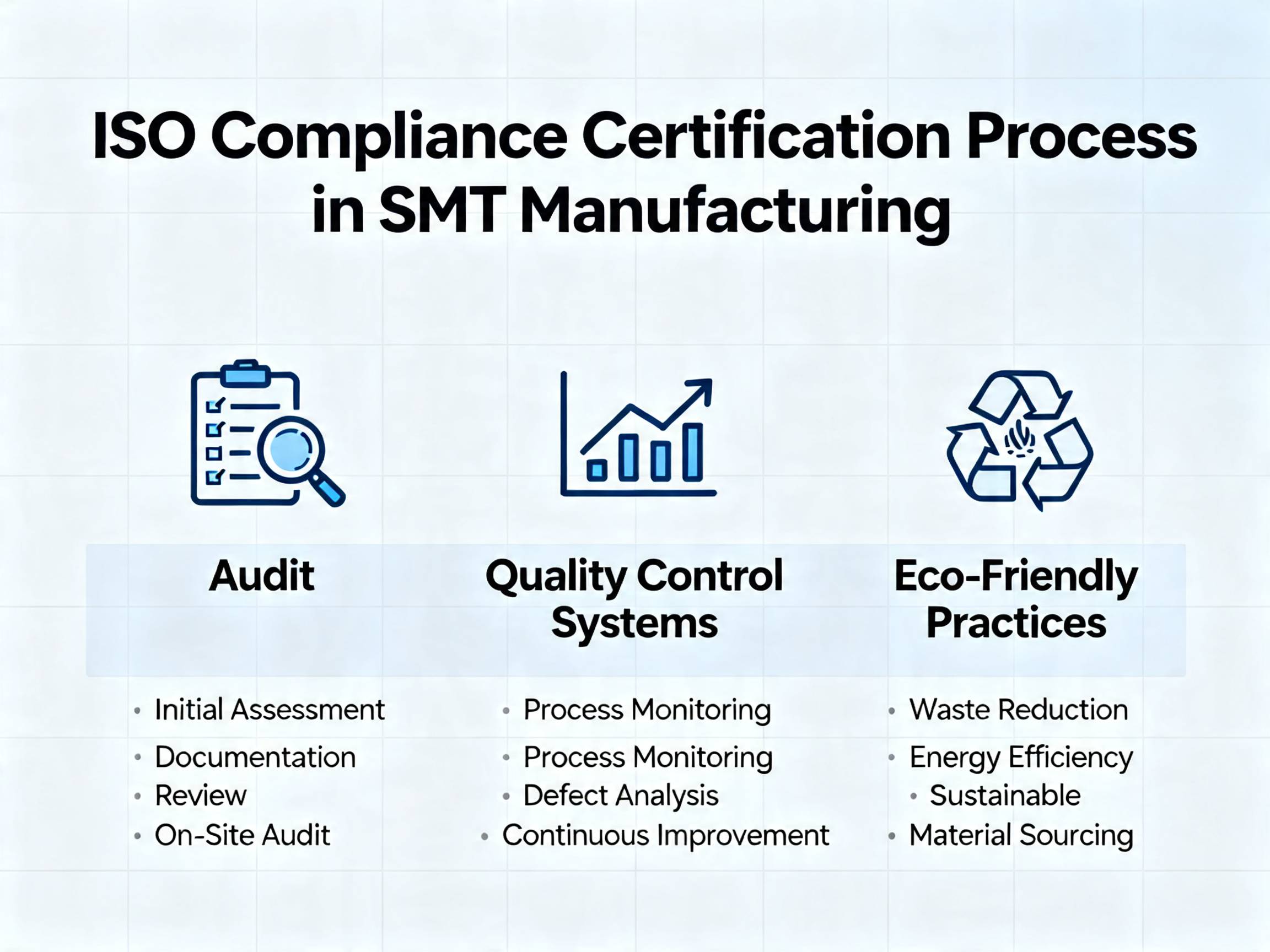
ISO Standards for SMT Compliance: Why They Matter in Manufacturing Today
Meeting ISO standards is not just about bragging rights. For SMT manufacturers, compliance ensures high-quality products, efficient processes, and credibility with customers. Let’s explore the most relevant ISO standards for SMT manufacturing, why they’re so important, and how facilities can get certified.
Overview of ISO Standards for SMT Manufacturing
ISO standards provide the guidelines for ensuring safety, quality, and efficiency in various industries, including SMT manufacturing. For electronics production, two critical ones are:
- ISO 9001: Quality Management Systems: This standard ensures the organization consistently delivers quality products by streamlining every step of its processes. It’s the backbone of effective manufacturing.
- ISO 14001: Environmental Management Systems: It focuses on minimizing a company’s environmental impact. Given the growing concern for eco-friendly production, this standard directly applies to reducing the environmental footprint of SMT processes like soldering.
These standards help SMT facilities operate with precision and consistency. They also encourage adopting sustainable practices, which is becoming more critical in 2026.
Benefits of Compliance
Why bother with certification? A company that meets ISO standards generally experiences these perks:
- Building Client Trust: Customers are more likely to partner with a manufacturer that sticks to global quality and environmental benchmarks.
- Fewer Defects: ISO 9001 emphasizes quality assurance, leading to fewer production line mishaps like misplaced components or soldering errors.
- Eco-Friendly Reputation: ISO 14001-certified companies demonstrate their commitment to reducing environmental impact. This aligns perfectly with the growing emphasis on green manufacturing.
- Market Expansion: Global customers often look for ISO compliance as a prerequisite for partnerships, opening up more opportunities to work internationally.
Steps for Certifying SMT Facilities
Getting certified for ISO standards may seem daunting, but it’s manageable with the right approach. Here’s how the process typically works:
- Evaluate Current Practices: Conduct an audit to identify areas that need improvement to meet ISO requirements.
- Implement Necessary Changes: Train staff, enhance workflows, and upgrade equipment if necessary. For example, advanced solutions, like Sun and Mountain’s automated SMT equipment, make compliance easier by already aligning with high precision and eco-efficiency standards.
- Document Everything: Keep detailed records of all procedures, especially around quality control and environmental practices.
- Hire a Certification Body: Partner with an accredited agency to assess your compliance. They’ll check everything from process consistency to sustainability efforts.
- Ongoing Audits: Certification isn’t a one-and-done deal. You’ll need regular audits to maintain compliance and ensure continuous improvement.
Pro Insight: Strategies for adopting eco-friendly soldering practices can significantly ease the ISO 14001 certification process. Adjusting reflow oven temperatures to minimize energy waste is one example provided by industry experts.
Conclusion
Adopting ISO standards in SMT manufacturing isn’t optional if you’re looking to scale operations in 2026. It’s a foundational step for improving quality, reducing environmental impact, and building trust with both clients and regulatory bodies.
Take the first step by performing a gap analysis of your current processes today. Whether it’s improving quality control or adopting eco-friendly practices, progress towards compliance can unlock new growth for your manufacturing facility. And remember, automated tools from companies like Sun and Mountain can make these steps smoother and more efficient.
Beyond Standards: The Future of SMT Manufacturing in 2026
As we wrap up this guide, one thing is clear. SMT manufacturing is evolving fast, and those who stay ahead of the curve will reap the rewards. We’ve covered the basics, benefits, and ISO standards that set the foundation for success in this industry. But what does the future look like?
The focus moving forward will be on scaling operations without sacrificing quality or sustainability. Companies are already embracing high-density PCB production, automated equipment, and eco-friendly practices in exciting ways. With advancements like predictive maintenance tools and smart assembly lines, factories are becoming hubs for innovation.
Expert Tip: Companies should weigh both cost and durability when choosing between SMT and Through-Hole applications. Remember, not every device benefits from miniaturization.
Encouraging Innovation in SMT Manufacturing
To stay competitive, manufacturers need to adopt cutting-edge solutions. Here are a few strategies:
- Automated Equipment Upgrades: Consider investing in tools like Sun and Mountain’s precision reflow ovens and PCB conveyors. They’re designed for reliability and integration.
- Focus on High-Density PCBs: Make room for more components in less space without compromising performance.
- Eco-Friendly Practices: Adjust processes like soldering to align with environmental standards.
- Train Your Team: A knowledgeable team can bridge the gap between equipment and optimum utilization.
From my perspective, I’ve seen firsthand how automation reduces errors and boosts scalability. Watching manufacturers transform assembly lines into efficient ecosystems has been a game-changer.
The Important Takeaways for 2026
If you’re part of this exciting industry, don’t forget:
- ISO standards build trust and credibility — get certified, refine your processes, and wow your clients.
- Automation isn’t just about efficiency; it’s about staying competitive in a fast-paced world.
- High-density PCB production is essential for the future of portable and compact devices.
- Eco-friendly processes aren’t optional anymore. They’re the key to long-term success.
The next step is clear: evaluate where your facility stands today and explore tools that can bring you up to speed with 2026 standards and innovations. Whether it’s compliance, automation, or scalability, the possibilities are endless.
Related SMT Equipment
Looking for equipment to support your manufacturing line? S&M offers a full range of SMT equipment:
- SMT Reflow Ovens — Nitrogen and air atmosphere, 8-15 zones, dual-track options
- Wave Soldering Systems — Standard and selective soldering, 350-610mm tunnel
- PCB Loaders & Unloaders — Magazine-based automated board handling
- PCB Buffers — Storage and cooling buffers for production line balancing
- Curing Ovens — UV and thermal curing for coatings and adhesives
Contact our application engineers for equipment recommendations and line configuration support.