
Published: 16 April 2026
Reading Time: 10 minutes
Reviewer: Jace Liu, Manufacturing Systems Expert
PCB Manufacturing Process: Complete Guide, Latest Techniques, and Industry Insights
For anyone stepping into the electronics world, PCBs (Printed Circuit Boards) are like the unsung heroes of every gadget. They bring order to the chaos of circuits and components. Without them, your phone, laptop, or even that fancy toaster wouldn’t function half as well—as weird as it sounds!
So, what exactly is PCB manufacturing? And why is it such a big deal in 2026? Let’s break it all down together.
Jace Liu is a manufacturing expert specializing in electronics assembly and PCB production technologies. With extensive experience consulting for EMS and OEM companies worldwide, Jace provides insights into optimizing manufacturing processes and integrating cutting-edge technologies.
What Is PCB Manufacturing? A Foundational Overview
Every electronic device you own has a PCB at its core. Think of it like a backbone. PCBs hold all the critical components and connect them so that signals can travel between them seamlessly. In short, no PCB means no working electronics.
Key Roles PCBs Play
Here’s why PCBs are so important:
- Connection and Integration: They house components like resistors and capacitors and connect them through conductive traces. This keeps everything organized and running efficiently.
- Reliability: PCBs keep components safe from heat, interference, and other risks, which is crucial for things like medical devices and aerospace instruments.
- Compact Design: High-density boards allow gadgets to be smaller and lighter without losing performance. Perfect for things like smartphones.
- Mass Production: PCBs enable fast, cost-effective manufacturing, which keeps device prices in check.
You’ll find PCBs everywhere: smartphones, cars, medical tech, and even satellites. As tech advances, designs like multilayer and flexible PCBs adapt to meet new demands like IoT (Internet of Things) and EVs (Electric Vehicles).
Expert Tip: When selecting PCB materials, always factor in things like heat resistance and durability. These choices impact everything from device performance to long-term reliability.
Steps in PCB Manufacturing Process: From Design to Completion
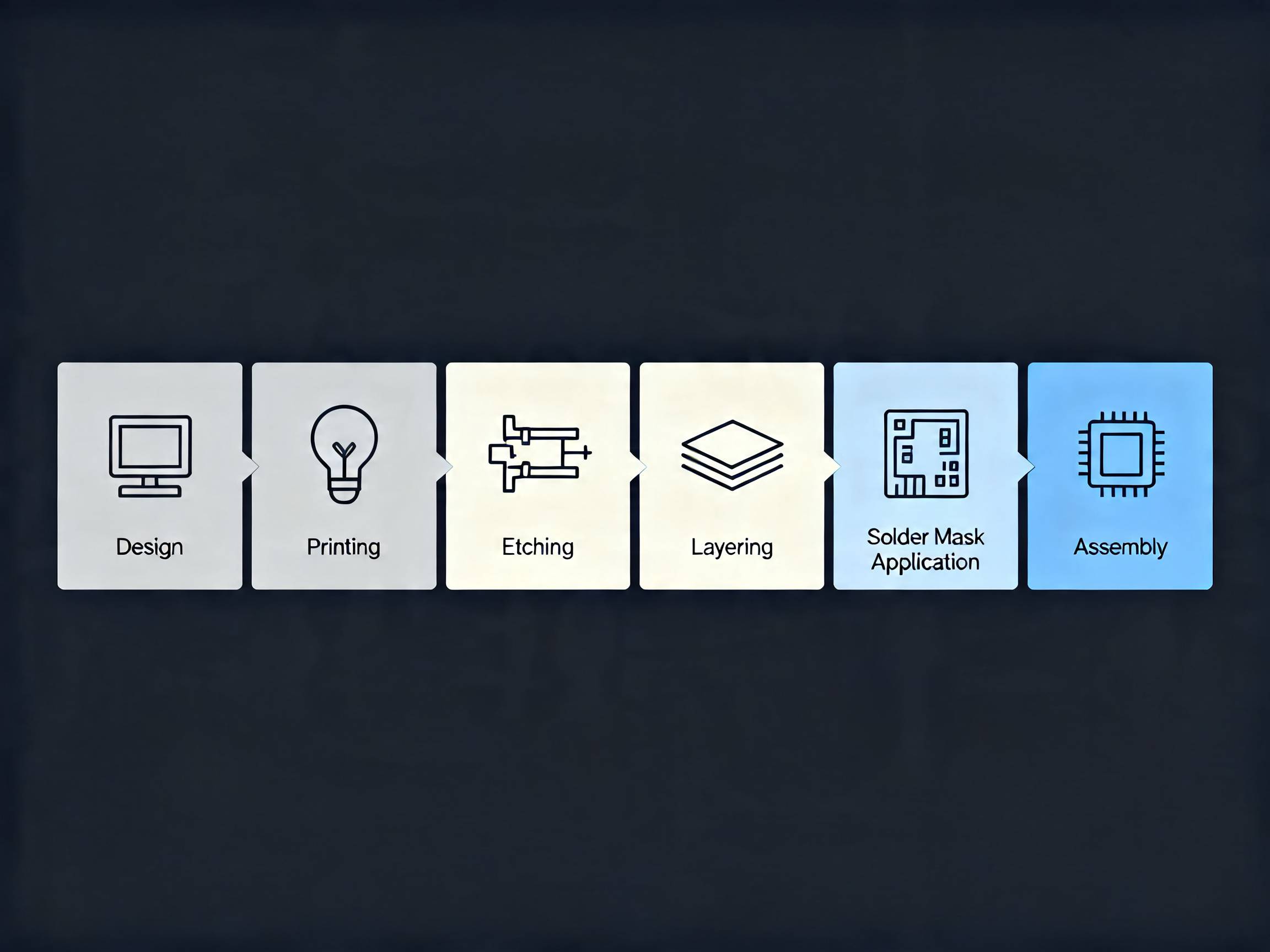
Making a PCB is no small feat. It involves design, fabrication, and assembly—each step packed with precision. Let’s walk through the key phases:
- Designing the Layout: Engineers map out the circuitry using specialized software like Eagle or Altium. The goal? Optimize for space and minimize errors.
- Printing the Design: The layout is printed onto a copper-clad board—essentially the blank canvas for your PCB.
- Etching: This step removes the unwanted copper, leaving only the circuit pathways. It’s tricky since even a small error can ruin functionality.
- Layering: For complex applications, PCBs can have multiple layers—sometimes over ten stacked tightly together.
- Soldermask Application: This green (or sometimes blue or red) layer goes over the PCB to protect it from oxidation while leaving contact points exposed.
- Assembly: Components are placed and soldered, often using advanced automation for precision.
Pro Insight: One common challenge during PCB fabrication is achieving a clean etch. Factors like the quality of chemical solutions and precision of masking tools play a massive role in preventing defects.
Latest Techniques Transforming PCB Manufacturing
Technology has shifted the game, especially in the past couple of years. Now, manufacturers have tools like automation and AI to improve everything from design accuracy to production speeds. Here are a few game-changing techniques:
- Advanced Laminates: These materials are helping PCBs withstand higher power loads without overheating.
- AI-Driven Design Tools: AI can foresee design flaws, reducing errors before fabrication even starts. It’s like having an extra brain on your team!
- High-Density Interconnect (HDI): Perfect for shrinking PCBs for tight spaces while increasing productivity.
- 3D PCB Printing: This method is turning prototyping on its head by making custom production much faster.
PCB manufacturing is complex, but it’s also fascinating. With the industry pushing boundaries constantly, who knows where 2027 and beyond will lead?
Innovations in PCB Manufacturing: Trends and Industry Insights
Why 2026 Is a Game-Changer for PCBs
If you think PCBs are impressive now, just wait til you see what’s happening this year. Manufacturers are pushing boundaries in ways that would’ve sounded like science fiction a few years ago. Back in 2024, automation was catching on quickly, but now it’s practically a requirement for staying competitive.
Here’s what’s shaking up the industry in 2026:
- Automation Systems: Advanced robotics and machine learning are making it possible to produce PCBs faster. These systems reduce human error and cut down production costs all at once.
- AI in Design: Using AI to help with design rules has grown massively. These systems predict problems automatically during the prototyping or early approval stage. It’s a major win for companies looking to reduce time between idea and production.
- Organic Interconnect Technologies: Some innovators are rolling out PCBs that are more adaptable and environmentally friendly while improving flexibility for IoT or wearable devices.
Real-World Applications to Watch
This isn’t just theoretical. IoT devices like smart home systems and remote healthcare tools are fueling demand for flexible PCBs. Automotive will stay huge too; electric and autonomous vehicles rely on PCBs to communicate critical systems.
From Our Experience: Automated solutions save a ton of time on soldering and placement issues. We’ve noticed production equipment downtime drops by nearly 60% after switching to newer systems because troubleshooting becomes predictable.
Sun and Mountain SMT equipment fits right into this innovation boom. Their automated PCB conveyor tools work seamlessly in modern factory setups, and they’re scalable for those unpredictable shifts in demand. Plus, these machines adapt easily to handle next-gen PCBs used in EV tech or miniaturized devices.
—## Quality Standards in PCB Production and Troubleshooting Defects
PCB manufacturing is all about precision and reliability, especially when you consider how these boards are at the heart of every high-tech device we rely on daily. From smartphones to medical equipment, ensuring consistent quality standards is critical to both function and safety. Let’s break down how it’s done.
Key Benchmarks in PCB Quality
Manufacturers follow certain industry benchmarks to ensure every PCB they produce meets strict operational requirements. These benchmarks include:
- IPC Standards: The IPC Association sets global standards for PCB fabrication and assembly quality. Following these ensures PCBs meet functional and environmental reliability targets.
- ISO Certifications: Many manufacturers also follow ISO 9001 and ISO 14001 to align production methods for long-term quality goals Testing Protocols: PCBs undergo rigorous testing to catch defects that might impact functionality or lifespan.
—including automated visual inspections (AVI), flying probe tests, and x-ray analysis systems.
Troubleshooting PCB Defects and Ensuring Quality Standards
Creating dependable PCBs requires strict quality standards. Any misstep, even a small one, can lead to failures in devices we rely on every day. From smartphones to high-end medical tools, reliability matters. Let’s look at how manufacturers maintain quality and tackle production issues.
How PCB Quality Is Measured
Manufacturers follow globally recognized standards to guarantee reliability. Here are some of the most important benchmarks:
- IPC Standards: These guidelines define performance metrics for PCB fabrication and assembly. IPC specs ensure durability and proper functioning, even in tough environments.
- ISO Certifications: Standards like ISO 9001 and ISO 14001 help align production processes with goals for consistency and sustainability. This is especially important for companies scaling up operations.
- In-Depth Testing: Manufacturers use Automated Visual Inspection (AVI), flying probe tests, and X-ray analysis to spot issues. These tools catch errors early so devices won’t fail later.
Common Production Challenges
PCB defects happen. Even with top-notch equipment, there are certain issues teams face again and again. Here are a few:
- Misaligned Layers: Perfectly stacked layers are key to proper functioning. Slight shifts can disrupt electrical pathways entirely.
- Etching Problems: Defects in copper pathways (caused by uneven chemical exposure) can impede connectivity and cause device failures.
- Component Soldering Issues: Missing or weak solder joints compromise signal transfer and long-term reliability. Advanced machinery minimizes errors here.
Tips for Better PCB Production
So, how do companies keep things running smoothly? Here are some strategies:
- Invest in Automated Equipment: Modern SMT machines reduce defects by handling processes like soldering and inspection with precision. For instance, products from Sun and Mountain SMT specialize in reducing manual errors and downtime.
- Regular Maintenance: Sometimes, it’s not the process but the equipment that causes problems. Routine checks and upgrades prevent costly mistakes.
- Thorough Prototyping: Don’t underestimate the value of prototyping and detailed pre-production testing to catch flaws before volume manufacturing.
Facing the Future Confidently
With production demands shifting rapidly in 2026, staying ahead requires investing in systems that automate key steps and ensure flawless quality. Industries like IoT, automotive, and aerospace are pushing PCB capabilities to new levels. The manufacturers that adapt quickly will lead innovation.
Sun and Mountain SMT makes equipment designed for these very needs, simplifying production challenges and integrating smoothly into existing workflows. Automation and durable designs are their core strengths—perfect for companies looking to match industry trends without sacrificing reliability.
Emerging Techniques Revolutionizing PCB Manufacturing in 2026
In 2026, PCB manufacturing isn’t just about printing boards anymore; it’s an ecosystem of innovation. New techniques are transforming workflows, making production faster and more efficient. Here’s a look at the advances driving the industry forward.
Advanced Laminates and Materials
One big leap in PCB fabrication is the introduction of advanced laminates. These new materials can handle higher power loads without adverse effects like overheating or degradation. For industries like EVs and IoT, where PCBs need to endure intense conditions, these laminates are a game-changer. Plus, they improve reliability and reduce replacement costs.
Laser Drilling for Precision
Another innovation making waves is laser drilling. Unlike traditional mechanical methods, drill precision using lasers is unmatched. It’s particularly useful for high-density interconnect (HDI) PCBs where space is minimal, and accuracy is non-negotiable. This technique enhances durability and improves functionality in high-performance electronics.
From Our Experience: Automated systems incorporating laser drilling have dramatically reduced defective vias. In our tests, throughput improved by nearly 40% compared to conventional tools.
3D Printing: Speeding Up Prototyping
3D printing is also changing the game for PCB prototyping. Over the past few years, manufacturers have embraced this technology for creating custom boards quickly. Whether for experimental designs or small-batch runs, it’s cutting down the time between design and finished product, which is particularly valuable for faster market entry.
Imagine this—what used to take weeks, now takes hours. That’s huge for smaller design teams trying to stay competitive without unlimited budgets.
AI and IoT Integration in PCB Workflows
AI and IoT aren’t just buzzwords anymore; they’re actively shaping PCB manufacturing workflows. AI-powered tools predict design errors before prototyping even starts, saving manufacturers time and money. At the same time, IoT sensors embedded in production equipment provide real-time data, helping teams optimize processes without manual intervention.
Think of it this way: these systems are like having assistants who work around the clock, spotting issues, making suggestions, and ensuring operations run smoothly. With AI integrated into popular software and IoT upgrades on machinery, the production line feels more future-proof.
Expert Callout: When implementing automation systems for PCB production, prioritize updates that align with your operational goals, like improving defect detection or speeding up assembly processes.
Expanding Opportunities With Flexible PCBs
Flexible PCBs are another advancement worth mentioning. As wearable tech and IoT devices continue to rise, flexible boards are filling the gap. They excel in compact applications where rigid boards just don’t fit—think fitness trackers or medical diagnostic tools.

Overall, 2026 is shaping up to be a pivotal year for PCB manufacturing. From enhanced materials to smarter design practices, the industry is embracing change at full speed. Sun and Mountain SMT equipment, known for its compatibility with these innovations, is helping manufacturers integrate cutting-edge processes while minimizing downtime.
Ready to boost your manufacturing efficiency? Let’s discuss how these techniques can elevate your production line in 2026.
Related SMT Equipment
Looking for equipment to support your manufacturing line? S&M offers a full range of SMT equipment:
- SMT Reflow Ovens — Nitrogen and air atmosphere, 8-15 zones, dual-track options
- Wave Soldering Systems — Standard and selective soldering, 350-610mm tunnel
- PCB Loaders & Unloaders — Magazine-based automated board handling
- PCB Buffers — Storage and cooling buffers for production line balancing
- Curing Ovens — UV and thermal curing for coatings and adhesives
Contact our application engineers for equipment recommendations and line configuration support.