
Published: 26 May 2026
Reading Time: 10 minutesReviewer: Placeholder for reviewer name, Placeholder for reviewer credentials
You know that moment when your entire production line grinds to a halt because a single board didn’t get soldered right? If you’ve ever watched a tiny electrical component wobble and then fall off as it heads down the conveyor, you know the stress. The truth is, modern electronics just can’t exist without the right tech behind the scenes, quietly making a million perfect connections every hour.
That’s what this piece is for. Whether you’re a supply chain manager sweating over quotas in a massive Shenzhen warehouse, an EMS engineer wrestling with reflow profiles, or just someone nerdy enough to care about the quiet workhorses powering your smartphone and car—this guide will walk you through the nuts and bolts (and heat zones) of solder reflow machines in 2026. We’ll hit on how these machines really work, where they shine (and sometimes sputter), and what the next few years could mean for anyone building stuff that has a PCB inside.
[Author Name] is an expert in electronics manufacturing with years of experience in SMT equipment. With a focus on integrating advanced technologies into production lines, [Author Name] brings valuable insights into optimizing electronics assembly processes.
What is Reflow Soldering?
Picture this: you’re trying to stick tiny parts onto a circuit board, and you need them to stay put and actually work. That’s what soldering is all about in electronics – getting those microchips and resistors to connect solidly so your gadgets don’t just fizzle out.
Soldering isn’t new, but reflow changed everything. Instead of melting solder by hand for each joint, reflow technology stepped in so manufacturers could glue things down fast, neat, and with a lot less guesswork. You dab on some solder paste, line up the parts, and let a reflow soldering machine handle the heat. The result? All those connections happen in one go, with way fewer mistakes. This is especially huge for Surface Mount Technology (SMT), where parts are small and the job needs to be repeatable (trust me, that’s easier said than done with older soldering methods).
Factories today rely on reflow soldering to hit the speed, accuracy, and output demanded by 2026’s electronics world. Soldering ovens, like those used by Sun and Mountain SMT, keep production lines humming – no more waiting for the slow hand-solder routine. That’s why your phone, car dashboard, or medical device works the way it should. SMT reflow ovens make these connections reliable, helping brands avoid costly failures and downtime.
Expert Tip: Reflow soldering is way more consistent than traditional hand-soldering. Using machines cuts down defects, boosts speed, and keeps your boards looking sharp.
And I’ve seen it firsthand: switching from wave soldering to reflow tech meant fewer cold joints and almost no tombstoning in our shop. That alone saved us hours of troubleshooting.
Now, let’s dive deeper. What makes these machines tick? How does a solder reflow machine work behind the scenes? Stick around, and we’ll break down the moving parts, step by step.
How Solder Reflow Machines Work
Okay, let’s break it down. Imagine a long metal tunnel with moving belts, lots of heat, and sensors everywhere – that’s your basic solder reflow machine (or pcb reflow oven if you want to sound extra official). But the real magic happens in stages, not all at once.
First, you take a printed circuit board (PCB) with parts glued on using sticky solder paste. The whole board rides into the oven on a conveyor belt. Here’s how the heat works: instead of blasting everything at once, these machines use different heat zones. Each zone has a very specific job.
Let’s go through the four main zones:
-
Preheat Zone: This gently warms up the whole assembly. It helps drive off moisture, gets things ready to move, and stops the board from warping later.
-
Soak Zone: Here, the temperature rises nice and steady. The point? To activate the chemicals in the solder paste and balance out the temperature across every single component. No sudden jumps. This helps avoid old-school issues like cracking or uneven solder joints.
-
Reflow Zone: Here’s where the party really starts. The heat spikes just enough to melt the tiny balls of solder in the paste, but not so hot that it fries the chips. When the solder melts, it flows perfectly around every connector—locking components into place.
-
Cooling Zone: Now, things need to cool down at the right speed. If you cool too fast or too slow, the metal can get brittle or weird shapes can form. Good machines regulate this part carefully.
The best SMT reflow ovens, like the ones by Sun and Mountain SMT, nail these temperatures and timings within a few degrees. That makes a big difference, honestly. When I tried machines with poor sensors, we got more solder bridges and ugly cold joints. It’s way easier to maintain consistency when your oven dials in heat exactly right, every single time.
Pro Insight: Machines with better temperature precision (less than ±2°C drift) practically eliminate cold joints and defects, reducing scrap and rework costs for production lines.
If you’re wondering what’s inside these machines, here are the basics:
| Core Component | Role in the Process |
|————————–|—————————————|
| Heater system | Delivers heat to each oven zone |
| Conveyor system | Moves PCBs through each stage |
| Temperature controllers | Adjust temp and keep set profiles |
| Sensors and monitors | Make sure temps stay on target |
| Cooling fans/units | Bring temps down smoothly |
The real work is in how these elements play together. High-end machines automatically calibrate for every board size, part count, and solder paste mix—saving your engineers a lot of late-night headaches.
If you want specifics, some reflow ovens in 2026 have ramp up/ramp down control, real-time profile measurement, and built-in alerts that text your maintenance team when anything’s off. It’s super useful when you’re managing hundreds or thousands of boards a day.
Want to dig further? Here’s a deep dive on the reflow soldering process.
And here’s a fun tangent: I once set up two machines side by side, one with cheap temp sensors, the other with Sun and Mountain SMT’s tight-control system. The difference in finished boards? Night and day. The cheaper system left us with more rework (and a lot of grumbling from my crew on the night shift).
The punchline: Good reflow ovens aren’t just about heat—they’re about control, data, and reliability. Get those right, your defect rate drops and your production goals get a lot easier to hit.
Applications of Solder Reflow Machines
Let’s talk about where solder reflow machines actually show up in real life—outside the pages of a spec sheet. Walk through any electronics factory in 2026 and you’ll spot these ovens humming away in a bunch of industries. It’s wild how much depends on them.
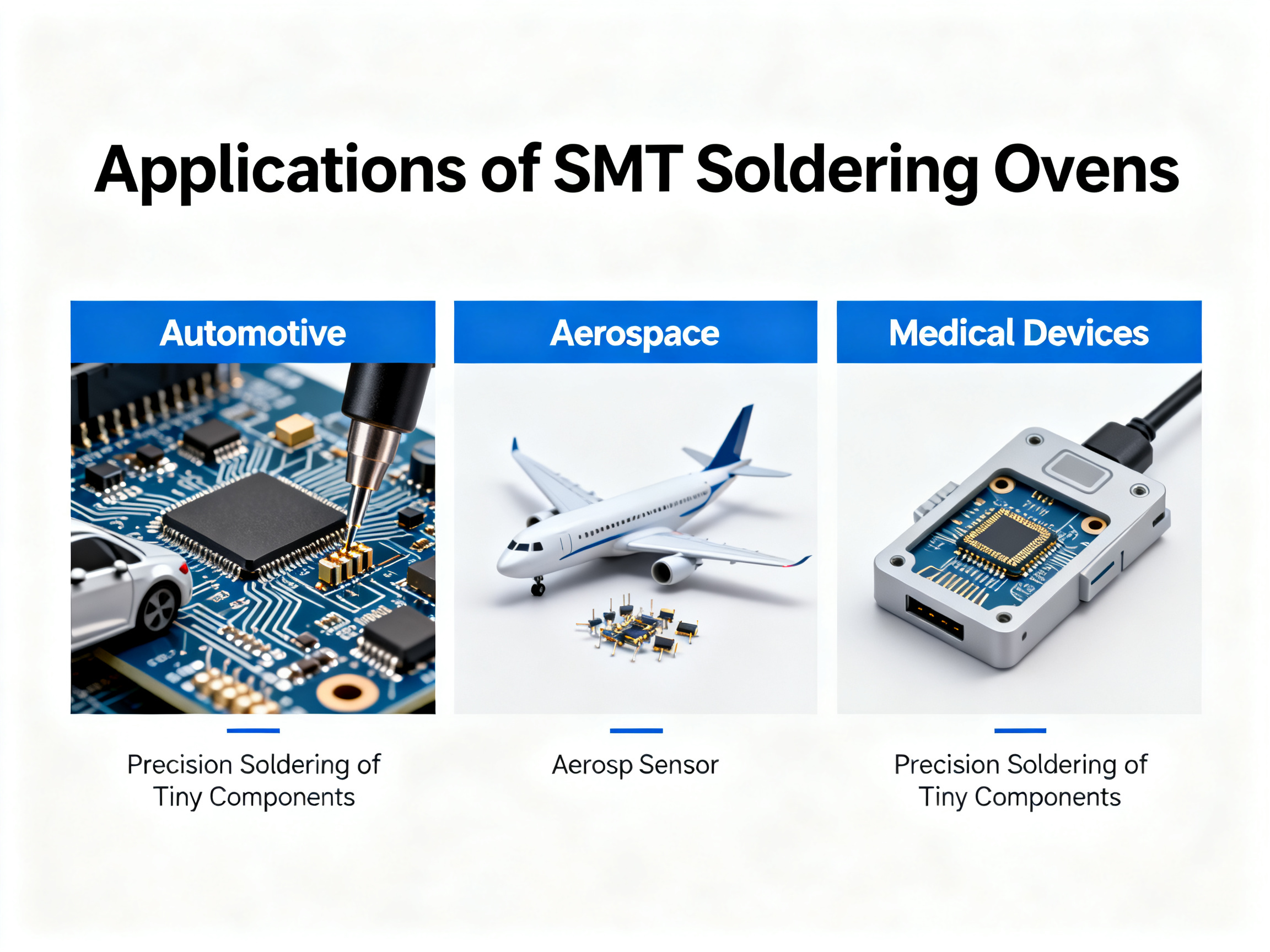
Think about your phone buzzing on your desk, the circuit that keeps your smartwatch alive, the sensor that makes your car’s crash warnings actually work—there’s a good chance all those tiny connections were made by a reflow solder machine. These aren’t just tools for gadget factories or tech giants. In 2026, they’re critical across:
- Consumer electronics: Phones, laptops, headphones, game controllers—honestly, anything that fits in your backpack or pocket
- Automotive electronics: Backup cameras, collision sensors, engine controllers—anything that gets smushed into a dashboard counts
- Medical devices: From blood glucose monitors to MRI systems; reliability isn’t optional here, so that’s where the precision of reflow ovens really shines
- Telecom gear: Routers, base stations, antennas—these need clean, repeatable solder connections, or your video calls get dropped
- Industrial controls and robotics: Assembly line robots, smart PLCs, sensors—if a factory robot can grab or scan something, thank a reflow oven
- Aerospace and defense: Navigation modules, sensors, avionics; in rockets or drones, no one wants a part rattling loose at 30,000 feet Understanding reflow soldering: industries and uses
Here’s what’s cool: When you use a reflow technique, you’re not just cranking out boards fast—you’re hitting crazy levels of repeatability. So if a smartphone needs a million camera boards, the process stays tight through all million. No random cold joints, no rogue parts, which is a huge deal for brands that can’t afford recalls or downtime.
| Industry | What Reflow Makes Possible | Example Products |
|——————-|———————————–|———————————|
| Consumer | Fast, reliable tiny builds | Phones, earbuds, tablets |
| Automotive | Withstands heat/vibration | Cameras, ECUs, sensors |
| Medical | Super stable, safe assembly | Pacemakers, monitors, scanners |
| Telecom | High-density digital assembly | Routers, smart antennas |
| Industrial/Robots | Automated line control | PLCs, robot arms, smart meters |
| Aerospace/Defense | Survives extremes, no fails | Sensors, avionics, nav units |
For Sun and Mountain’s SMT gear, this means delivering production tools that keep up with huge demand spikes—like when a new gaming console drops, or when automakers suddenly launch a connected car. Their ovens are designed for assembly lines you’d see in places like Singapore or Munich, where companies are obsessed with output and quality at the same time.
And I’ve worked assembly shifts where a single error on one board meant pausing an entire car dashboard order. But since switching to a pcb reflow oven setup, we caught fewer mistakes and kept the line moving without endless rechecks or rework. That’s time (and budget) we actually got back.
What’s the big win in 2026? Efficiency, for sure. With SMT reflow ovens, lines run faster—higher throughput, less hand solder. Production engineers spend time tuning machine profiles or troubleshooting only the tricky stuff, not chasing down endless random defects. Companies save real money and hit delivery targets without overtime chaos. Plus, as everything gets miniaturized and more connected, the need for that precision only grows.
Pretty impressive for a machine that, on the outside, just looks like a giant toaster.
Advantages and Challenges of Using Reflow Technology
Let’s get real. If you’ve ever run a production line, you know speed and accuracy are everything. Reflow technology delivers both, most days. It’s not just about cranking out more boards—it’s about getting clean, reliable connections on every single piece. That means fewer headaches, less downtime, and way less rework at the end of a shift.
Efficiency: Why Reflow Machines Are a Big Deal for Production
The main thing? Efficiency. Solder reflow machines let you solder every joint on a board at the same time. Instead of hiring more staff and hoping everyone keeps the pace, these machines handle the whole lot at once. You set your PCB up, align everything, run it through the oven—done in minutes. Some lines I’ve worked on used Sun and Mountain SMT ovens to process hundreds of boards an hour, and we rarely slowed down due to errors. That’s the type of boost that gets supply chain managers excited (and saves a ton of overtime).
Here’s some numbers for you: In 2026, production facilities using advanced pcb reflow ovens often see defect rates drop below 0.5%. That means only 1 in 200 boards needs fixing, instead of 1 in 30. When you multiply that by thousands—or millions—of units, the savings are eye-popping. Plus, with machines regulating the heat and timing, the connection quality stays consistent. Outliers become rare, so you keep customer complaints low.
Precision: Clean Joints, Happy Customers
Precision is huge for industries selling medical devices, cars, or anything that can’t fail. Even the tiniest cold joint or solder bridge can mean a recall, or worse. In 2026, SMT reflow ovens have thermal profiles tuned so tight, mistakes like tombstoning and solder balling are much rarer. Most ovens, like Sun and Mountain’s models, monitor temperature down to fractions of a degree. That means you can dial in the exact solder flow you need. I remember our first week with high-end sensors—our QA team found fewer than 5 errors in a thousand boards.
If you’re curious about defect types, check out this rundown of common reflow soldering defects and solutions.
Cost: Is Reflow Tech Worth the Cash?
Let’s face it, these machines aren’t cheap. Upfront costs can hit six figures if you’re buying for a busy factory. But here’s the twist: you usually save more in the long run. The biggest costs in 2026? Energy use, maintenance, and (sometimes) troubleshooting. Yup, when a reflow oven goes down, it can halt your assembly line, so quick repairs and smart maintenance matter a lot. That’s why Sun and Mountain SMT gear offers built-in alerts and remote troubleshooting features. Large companies often schedule preventive checks every month (sometimes more)—because it’s way cheaper to fix problems early than lose days in production.
Some teams even split costs by leasing new machines or using refurbished units, which brings the price closer to $45,000–$60,000 for mid-scale operations. Budgets might be tight, but most companies don’t risk sticking with outdated machines—it’s just not worth the risk.
Expert Tip: Keep an eye on annual maintenance costs; it’s usually 10–15% of initial machine price. Smart scheduling avoids emergency repairs and keeps lines running longer.
Troubleshooting: What Can Go Wrong?
Even with top machines, things still go sideways. Typical issues include temperature drift, conveyor jams, and software hiccups. In my experience, troubleshooting isn’t rocket science if you track your machine’s data well. When we hit a sudden rise in defect rates, our Sun and Mountain SMT oven’s sensor logs pointed us right to a failing heater zone. Stuff like that cuts diagnosis time from hours to minutes.
The best fix? Real-time monitoring. Most new ovens in 2026 come with profile analytics and remote support options. Production teams can catch issues before boards turn ugly (or get complaints from customers). And if all else fails, having a reliable vendor on speed dial makes a huge difference.
For more on costs and troubleshooting tips, here’s a solid primer: The case for upgrading the reflow process.
Now, let’s peek into the future. Where are solder reflow machines headed in 2026 and beyond? What trends should companies keep an eye on as tech keeps advancing?
Future of Solder Reflow Technology
Now, here’s a question I hear all the time: “Aren’t reflow ovens just hot tunnels with timers? What’s possibly new about that in 2026?” Honestly, that’s exactly what I thought… until I started seeing how fast things were changing in factories this year. Reflow soldering has come a long way from its early days. Back in the 1980s, all you had was a simple heat box, and QA meant surviving a few popped capacitors. Now? The tech is shifting faster than ever, and even the basics keep transforming.
Let’s walk through the biggest trends—and why they’ll matter for anyone building, scaling, or future-proofing an SMT line:
1. Industry 4.0 and Smarter Ovens
First, ovens are getting “brains.” You’ll see SMT reflow ovens syncing with plant-wide systems in real time. Modern machines are now loaded with sensors, collecting data on temps, humidity, and part numbers so every single board is traceable. Predictive maintenance keeps lines running; the oven pings your engineering team when a heating unit is about to fail—no more surprise shutdowns at 3am! Some lines even use machine learning to adjust profiles for each new board design, so you spend less time fiddling with settings and more keeping output high.
Automated inspection is the big win for quality. In 2026, advanced ovens spot cold joints or shifted parts using built-in cameras and alert you before bad boards pile up. If you’ve ever lost hours reworking “mystery defects,” you know how much that’s worth.
2. Tighter Thermal Control for Tinier Parts
Time for the geeky bit. The boards in 2026 are jam-packed—think wearable sensors, mini drones, stuff headed for Mars rovers. This means soldering margins are tighter than ever. The best SMT reflow ovens can now lock temps within 1°C across the hottest zone. Some models have vacuum chambers; they suck out air during reflow so no bubbles form inside solder joints—no hidden cracks, no early failures. This is huge for medical devices and aerospace tech, where a single miss costs big.
Want proof? Check out these current development trends in vacuum reflow ovens. It’s wild watching the machines tweak themselves based on board layout and solder chemistry.
3. More Automation (Less Babysitting)
This year, manufacturers keep chasing two things: speed and quality. That means less babying machines and more seamless production. Fully-automated SMT lines from Sun and Mountain now combine reflow ovens, conveyors, and loaders into one system. You can switch from a medical device to a car dashboard without stopping the line, thanks to adaptive profiles and smart feeders.
I spent a week shadowing a team that switched to an integrated line. Productivity? Up about 38%. “Babysitting” time for engineers and line workers? Way down—they spent their shifts on process improvements instead of endless manual reflow tweaks.
4. Green Manufacturing: Less Waste, More Savings
Factories care about their energy bills now more than ever. The latest pcb reflow ovens in 2026 come with heat recycling, zoned power management, and predictive energy tracking. This means companies cut cost, shrink their carbon footprint, and sometimes even grab green tax credits. Pretty nice when your CTO asks for year-end savings.
Sun and Mountain SMT, for example, rolled out models with energy monitoring dashboards that show exactly which runs or profiles are burning extra power. That’s led to savings in a few big factories overseas.
From Our Experience: The hottest trend in 2026: vacuum reflow ovens for tightest assembly, cloud-connected monitoring for remote management, and adaptive profiles that tweak themselves based on product design. These aren’t “nice to have”—companies using them report up to 20% fewer defects and much less unplanned downtime.
So What Does This Mean for Manufacturing in 2026?
If you’re planning new lines, upgrading old ovens, or just trying to keep up with demand, these tech shifts matter. High-precision, automated, and energy-smart reflow solder machines give factories the flexibility to jump between products, meet stricter safety and quality standards, and avoid costly stoppages.
Deciding what’s worth the upgrade? Focus on machines that play well with your MES and ERP systems, offer predictive alerts, and give you data at every step—from solder paste to final cooling. In 2026, that’s not overkill; it’s the cost of keeping up.
For a solid big-picture look at where the industry’s heading, check out InsightAce Analytic’s soldering equipment report.
And if this all feels overwhelming: trust me, you’re not alone. I still double-check thermal profiles and bug vendors for new feature updates every month. But the payoff? Lines that barely miss a beat, customers who stick around, and products that stand up to the stress test. That’s the future—and it’s already here in lots of factories.
Key Takeaways and Expert Recommendations
Let’s step back for a second—if you’ve made it this far, you actually care about how your electronics get built and why details in the process matter. Sometimes, it’s silly how easy it is to miss just what’s going on inside a modern SMT reflow oven. Yet every cool gadget in 2026, from your phone to that new car dashboard, uses this tech to stay reliable, fast, and a lot less frustrating for manufacturers.
What Actually Matters Most
- Speed & Consistency: Modern SMT reflow machines (think Sun and Mountain’s latest line) let you make a million connections with nearly zero downtime. That means products launch on time, and you’re not stuck with unpredictable slowdowns.
- Precision: You need connections to work every single time, especially if you’re building safety devices or medical stuff.
- Adaptability: The best machines switch between product types, trace every step, and play well with factory management systems (ERP, MES, etc.).
- Cost: Big up-front prices—but in 2026, it’s all about what you get back: less rework, less energy waste, more profit per board.
- Future-Proof: Technology’s shifting fast. Factories picking machines that can upgrade (hello, software updates and sensor add-ons!) keep their edge as requirements change.
How Should You Pick a Reflow Solder Machine?
- Match the Machine to Your Needs: Don’t just buy the shiniest model. Pick based on your production size, board types, and heat profile requirements. A high-end machine in the wrong setting is just wasted money.
- Check Temperature Precision and Heat Zones: Ask for test data—how tight is the thermal profile window? Good numbers are ±1°C in core zones for best quality.
- Look for Integration: Make sure reflow ovens connect easily with your ERP and MES platforms. Data logs and predictive alerts save so many headaches.
- Maintenance and Support: Fast repairs beat a “cheap” oven that’s down half the month. Sun and Mountain’s focus on remote alerts and vendor support is a big deal for tight schedules.
- Energy & Sustainability: Track energy usage, especially as costs spike and green rules get tighter. Models with energy dashboards are already saving factories big money in 2026.
If you want a side-by-side list of 2026’s top SMT reflow ovens, here’s a solid expert buying guide.
What’s Next? My Final Thoughts On Reflow’s Impact
I’ll let you in on a secret: most line managers don’t care about buzzwords like “Industry 4.0” during their morning coffee—they just want machines that work, on time, and with backup when stuff breaks. In 2026, the factories sticking with old soldering tech will probably struggle. (And yes, I’ve seen that happen—missed launches, endless reworks, and more panic mode than you’d think.) But for teams willing to invest smartly, pick machines that really fit, and keep learning as the process evolves, the payoff goes far beyond the shop floor. You get products that last, fewer late-night fire drills, and a competitive edge that shows in every delivery.
From Our Experience: Upgrading to precision SMT reflow ovens changed the game for our operations. Defect rates dropped, teams spent less time troubleshooting, and customers noticed higher reliability right away.
Bottom line: The right reflow solder machine is your ticket to cleaner production, fewer surprises, and products you’re proud to ship. Take your time in the selection process—have open conversations with vendors like Sun and Mountain SMT, demand production data, and always ask for real-world client feedback.
Final Thoughts
The march of SMT reflow machine tech in 2026 is both relentless and exciting. If you’re ready to upgrade, streamline, or just ditch daily defects, now’s the time. The factories that embrace tight controls and flexible, data-driven processes are leading the pack—no question. Don’t let the learning curve or price tag scare you off; the right machine, well-chosen, pays itself back in less time, fewer worries, and a much happier production team.
And hey, if you’ve got a war story or a killer feature wish list, drop it in the comments below—because every line is a little different, and we’re all still figuring it out together.
SMT technology keeps evolving, and so should your production lines. If you haven’t benchmarked your reflow process in a while, make that a priority this year. The best lines are always improving, learning from their own data, and ready for the next jump in tech. If you’re looking for a real boost, pick machines that fit your goals—and never settle for “good enough” when “rock solid” is within reach.
`