
Published: 26 May 2026
Reading Time: 10 minutes
Reviewer: Simon Scrapes, Founder
You know that moment when a production line looks fine on paper, but solder quality still keeps slipping? A lot of SMT teams hit that wall. The profile says one thing, the board says another, and now everyone is staring at the oven.
That is one reason infrared heating still gets attention in 2026. It is not the default answer for every line, and it probably should not be. But for the right setup, an ir oven can heat fast, save energy, and fit shops that want a compact, focused solution for the SMT reflow process.
This guide breaks down how is oven works in infrared reflow, where an infrared oven industrial setup makes sense, and where it does not. We will also look at infrared reflow oven benefits, the trade-offs against convection systems, and what to think about before you buy or upgrade. If you are comparing options for an EMS or OEM line, this will help you ask smarter questions before you spend real money.
The author of this article is an expert in electronics manufacturing technologies, with a strong focus on Surface Mount Technology innovations. They have hands-on knowledge of infrared heating and how it fits into modern SMT production, especially for teams working to improve line efficiency and solder reliability.
Why infrared heating still matters in SMT
Infrared heating in SMT is pretty simple at heart. The oven sends radiant heat toward the board and solder paste, which warms the surface quickly. That quick response is a big part of the appeal. In some lines, especially where space, power use, or short cycle times matter, industrial infrared ovens still have a real place.
But here is the honest part. In 2026, many manufacturers lean toward convection or hybrid systems because they tend to heat more evenly across mixed assemblies and dense boards. Market overviews and supplier guidance keep pointing in that direction, especially for complex PCB builds that need tighter consistency across every run according to current reflow oven market coverage.
So why even talk about infrared? Because not every factory is building the same board, at the same volume, with the same budget. Some teams need speed. Some need a smaller footprint. Some are running products where targeted heating is still a smart fit. And if you are working with legacy lines, or trying to upgrade without ripping out everything, infrared heating technology can still be worth a close look.
What this article will cover
We are going to keep this practical.
Here is what comes next:
| Topic | What you will learn |
|—|—|
| How infrared heating works | The basic mechanism inside an IR reflow oven |
| Main benefits | Where fast heating and energy savings can help |
| Limits to watch | Why uneven heating can become a problem |
| Best use cases | When infrared oven industrial systems fit best |
| Buying and setup tips | What to check before adding one to your SMT line |
If you are reviewing equipment options from suppliers like Sun and Mountain SMT, this context matters. A machine can look great in a brochure. But the better question is whether it fits your board mix, throughput target, operator skill level, and maintenance plan. That is what actually decides whether a purchase helps, or just creates one more headache. Because nobody wants a shiny new bottleneck.
How Infrared Heating Works in Reflow Ovens
Here is the simple version. An ir oven uses radiant energy to heat the board surface, component bodies, leads, and solder paste. Instead of pushing hot air around first, the system sends infrared energy from heaters toward the assembly. That energy is absorbed at different rates based on the material, color, mass, and surface finish. And that one detail explains a lot.
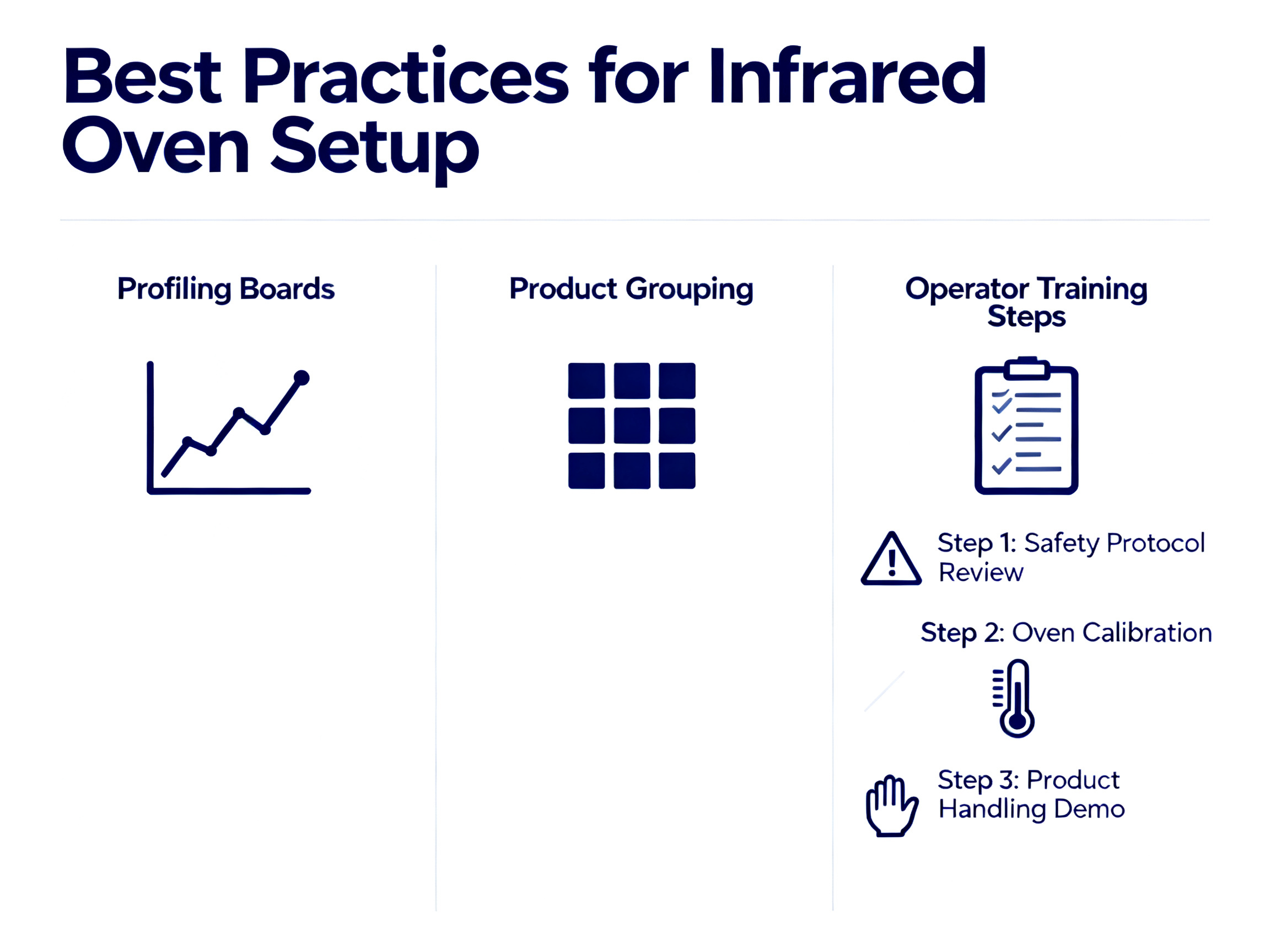
In the SMT reflow process, the goal is not just to get hot. The goal is to move through preheat, soak, reflow, and cooling in a controlled way so the paste melts, wets properly, and forms clean joints. With infrared heating in SMT, the board can respond very fast. That speed is useful. But it also means the setup has to be tuned with care, because one part of the assembly may absorb heat faster than another.
From what we have seen on electronics lines, that is where teams either start trusting an infrared setup, or start blaming it for every solder defect by Friday afternoon. I have seen lines where a simple board profile looked great on paper, but darker components heated much faster than nearby reflective parts, and the gap showed up in the final joints. That is not magic. It is just how infrared heating technology behaves.
Pros and Cons of Infrared Reflow Ovens
This is the part most buyers care about. Does an infrared oven industrial setup actually help, or does it create more tuning work than it saves?
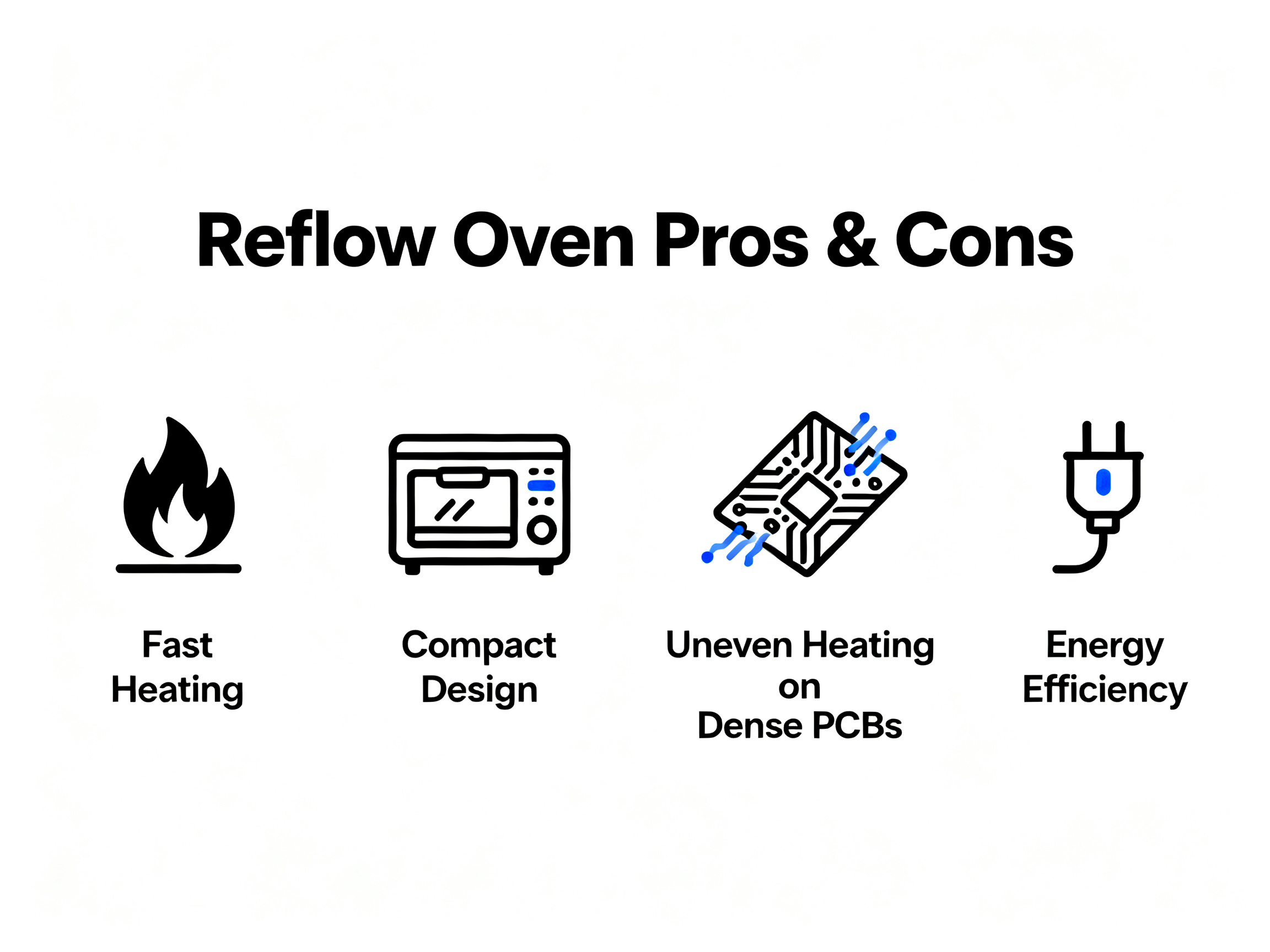
The good news first. Infrared reflow oven benefits can be very real in the right factory. Heating is fast. Power use can be lower. The machine footprint can be smaller too, which matters more than people admit. Floor space is expensive, and nobody likes squeezing one more machine between a screen printer and inspection.
Where IR ovens tend to shine
- Fast thermal response
- Lower energy use in some setups
- Compact machine design
- Good fit for simpler or more repeatable board types
- Useful for legacy lines or targeted process upgrades
We have seen this kind of setup make sense when the board mix is stable and the process team knows exactly what thermal behavior to expect. In those cases, infrared heating in SMT can be a practical, cost-aware option instead of an overbuilt system with features the line may never use.
But there is a trade-off. Actually, more than one.
Where IR ovens can struggle
- Uneven heating across mixed materials
- More sensitivity to board color, mass, and layout
- Greater risk on dense or high-complexity assemblies
- Extra process tuning for repeatable quality
- Often a weaker fit than convection for broad product mix lines
That uneven heating issue is the big one. Industrial guidance still points out that convection systems usually offer more uniform heating across complex PCB assemblies, which is a major reason they remain the common choice for advanced lines in 2026 as explained in this reflow oven guide.
I have worked with teams that loved IR for one product family and hated it for the next. Same oven. Different boards. That is the honest truth. If your line handles simple, repeatable builds, IR may feel quick and clean. If your product mix swings all over the place, things can get messy fast.
Side-by-Side Comparison: Infrared vs. Convection
Final Take
Infrared reflow ovens still matter in SMT in 2026, but they work best as a targeted solution, not a universal one. If your boards are stable, your space is tight, or your line needs faster, focused heating, an ir oven may be a smart choice. If your product mix is dense and unpredictable, convection or hybrid systems will often give you a wider safety margin.
The best next step is simple. Profile your real boards, compare your defect risks, and talk with suppliers about fit, not just features. If you are reviewing new SMT equipment, this is a good time to map your board mix and throughput goals before you commit. That one step can save a lot of pain later.
The strongest SMT teams do not buy heating technology because it sounds modern. They buy the system that matches their boards, operators, and quality targets, then they validate it with real profiling before trusting the brochure.