
Published: 26 May 2026
Reading Time: 12 minutes
Reviewer: [Reviewer Name], [Reviewer Credentials]
You know that moment when a production line is waiting, the boards are pasted, the parts are placed, and everyone is staring at the oven settings like they might magically explain themselves? Yeah, that’s usually when the choice between a batch and continuous SMT reflow oven stops being a theory question and becomes a money question.
If you’re comparing options in 2026, you’re probably not just asking what is SMT reflow oven equipment. You’re asking which process fits your line, your mix, your budget, and the kind of solder joints you need day after day. Fair question. A good smt reflow oven process does one simple but very big job: it heats solder paste in a controlled way so surface-mount parts bond to the PCB without cooking components or warping the board. That sounds basic. It isn’t.
A pcb reflow oven matters because tiny thermal mistakes can turn into open joints, tombstoning, voids, or boards that fail later in the field. And nobody wants that call.
This guide gives you a plain-English look at reflow oven pcb basics, why these systems matter in electronic assembly, and where batch and continuous ovens fit. We’ll also touch on smt reflow oven profile choices, pcb reflow oven temperature ranges, and what buyers should watch if they’re planning for growth in 2026.
[Author Name] is an experienced electronics engineer specializing in PCB design and SMT assembly processes. With over [X] years in the industry, [Author Name] has a deep understanding of manufacturing technology and innovations, contributing strong hands-on insight to improvements in SMT processes.
What is an SMT reflow oven?
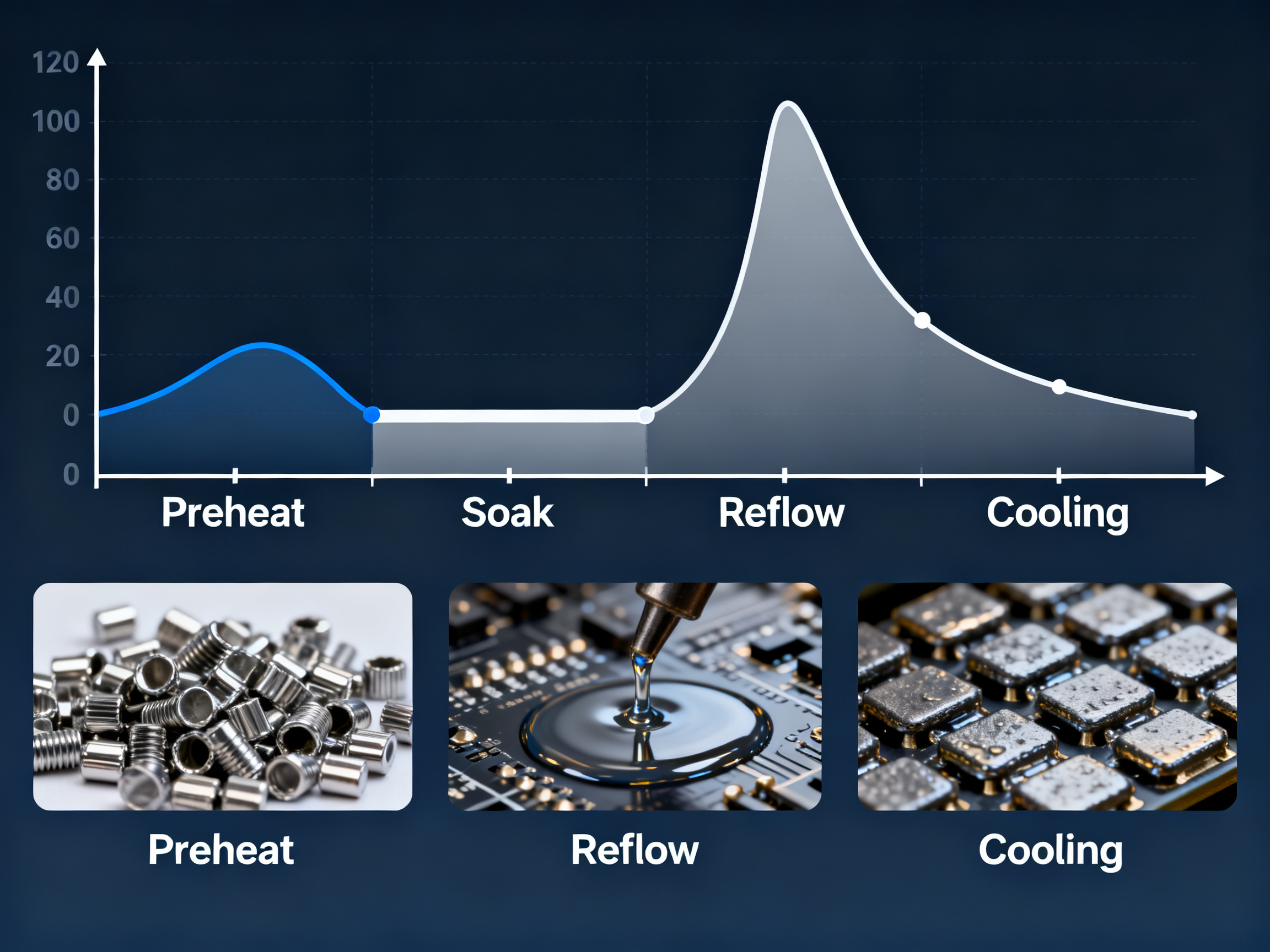
At its core, an smt oven reflow system heats a populated circuit board through a set thermal path so solder paste can activate, melt, and then cool into solid joints. Most setups follow four familiar stages: preheat, soak, reflow, and cooling. A helpful overview from ZenTech on the five stages of SMT reflow ovens explains how each stage helps protect parts while forming reliable solder connections.
Here’s the simple version:
| Stage | What happens | Why it matters |
|—|—|—|
| Preheat | Board warms gradually | Lowers thermal shock and starts solvent evaporation |
| Soak | Temperature evens out | Helps flux activate and balances hotter and cooler areas |
| Reflow | Solder goes above melting point | Forms the electrical and mechanical joint |
| Cooling | Joint solidifies in a controlled way | Supports joint strength and finish |
So, what is pcb reflow oven equipment used for in real shops? Pretty much every modern surface-mount assembly line depends on it. Whether you’re using a desktop smt reflow oven for NPI work or a larger reflow oven for pcb volume runs, the goal stays the same. Repeatable soldering.
And that’s the key word. Repeatable.
Why reflow ovens matter in electronic assembly
A reflow oven smt setup is not just a hot box. It’s one of the main quality gates in PCB assembly. The oven decides whether printed paste and placed parts become dependable product, or become expensive scrap.
In day-to-day manufacturing, the oven affects:
- solder joint quality
- component safety
- throughput
- defect rates
- consistency from board to board
- how easily a line can scale
We’ve seen teams spend hours tuning stencil design and pick-and-place accuracy, then lose yield because the thermal profile was off by a little too much. That hurts, especially on dense boards with mixed thermal mass.
If you’re wondering how to use reflow oven settings the right way, start with this idea: the board should follow the paste maker’s profile window, not just the oven’s display temperature. Those are not always the same thing.
For EMS and OEM teams, this is where equipment choice gets practical. A supplier like Sun and Mountain SMT, for example, fits naturally into this discussion because their reflow systems are built around precision, line integration, and stable production output. If your shop is trying to cut downtime while keeping yields steady, that kind of fit matters a lot more than flashy specs on a brochure.
Batch and continuous reflow, the two main paths
When people compare ovens, they usually end up here fast. Do you need batch processing, or do you need continuous conveyor-based flow?
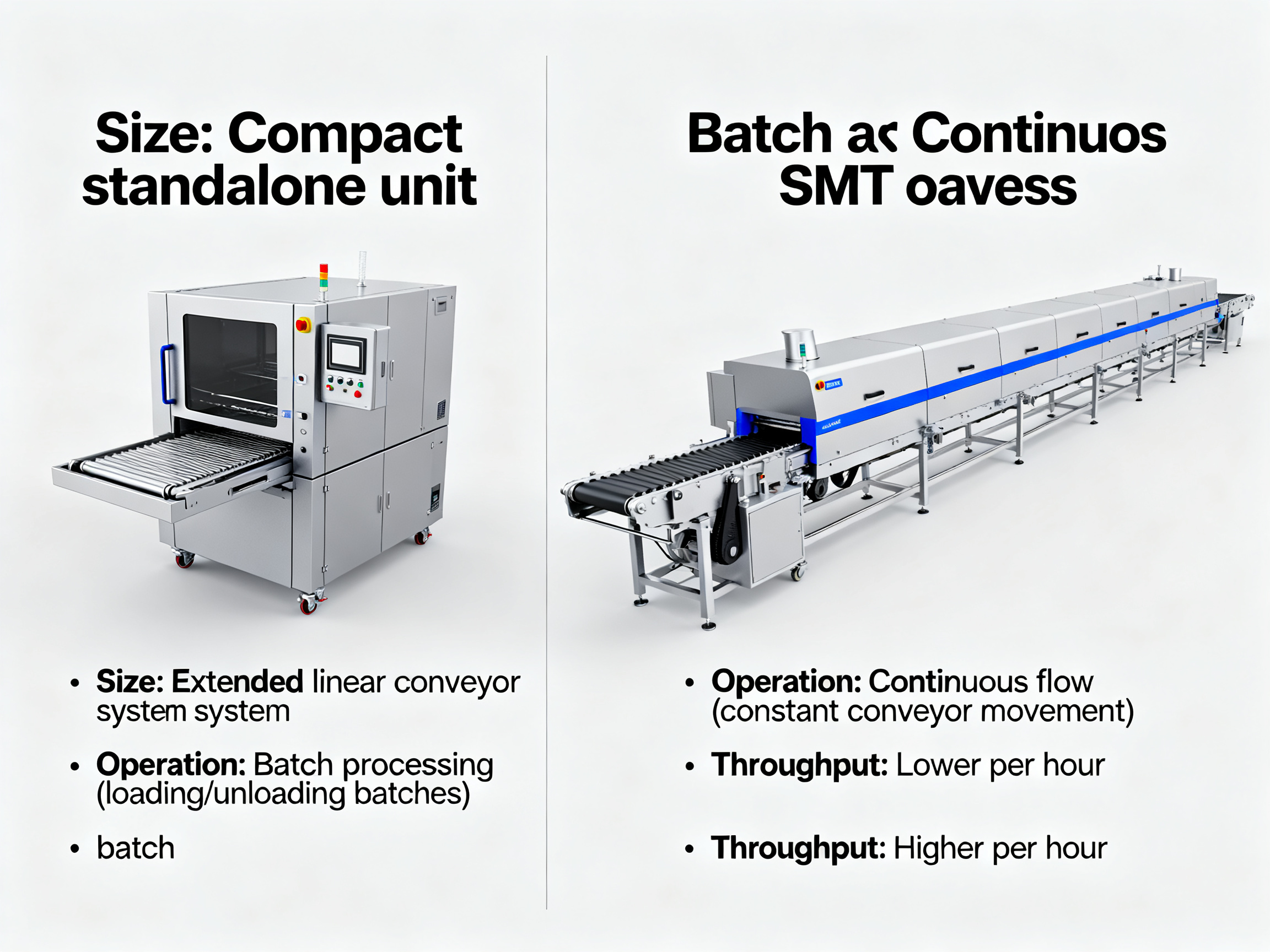
Batch ovens process one load at a time. You load boards, run the cycle, then unload them. Continuous ovens move boards through heated zones on a conveyor in an ongoing stream. According to SMT Factory’s comparison of inline vs batch reflow ovens, batch systems tend to suit low-volume, high-mix work, while inline systems are a better match for higher-volume production and line automation.
That sounds neat and tidy. Real life is a little messier.
Some companies need flexibility more than speed. Others need nonstop output and traceable consistency. And some are in the awkward middle, where today’s prototype cell becomes tomorrow’s production bottleneck.
Here’s a quick side-by-side view:
| Feature | Batch SMT reflow oven | Continuous SMT reflow oven |
|—|—|—|
| Board flow | One load per cycle | Constant conveyor movement |
| Best fit | Prototypes, labs, short runs | High-volume, stable production |
| Changeover | Usually easier | Usually slower if product mix changes often |
| Footprint | Often smaller | Often larger |
| Throughput | Lower | Higher |
| Line integration | Limited to moderate | Strong |
| Upfront cost | Often lower | Often higher |
So if you’re asking how to reflow a circuit board in an oven, the answer changes based on scale. A diy pcb reflow oven or compact batch unit may be fine for test builds. But if you need hundreds or thousands of assemblies a shift, continuous processing usually starts to make more sense.
The next sections of the article will build from this starting point and break down batch ovens, continuous ovens, temperature profiling, and how to choose the right path for your boards, your team, and your 2026 production goals.
[Editor’s Note: This blog post continues with sections outlining in-depth comparisons between reflow processes tailored for both batch and continuous production strategies. Stay tuned for further updates in part two “Choosing the Right SMT Oven for Maximum Yield.”]