
Published: 20 May 2026
Reading Time: 10 minutes
Reviewer: [Provided Reviewer Placeholder], Industry Expert in SMT Technology
How Reflow Soldering Works: Step-by-Step Guide to Mastering Reflow Ovens
Reflow soldering might sound complicated, but it’s actually one of the most important techniques in modern electronics manufacturing. Have you ever wondered how those tiny, complex circuit boards inside your favorite devices are assembled with such precision? That’s the magic of reflow soldering at work.
This process is critical for assembling printed circuit boards (PCBs) using surface-mount technology (SMT). By carefully heating solder paste, components, and PCB material, manufacturers achieve high-quality connections that are both durable and efficient. SMT reflow ovens take center stage in this process, paving the way for faster, scalable, and more reliable production in industries like consumer electronics, automotive, and even aerospace.
But why is this process such a big deal? It’s all about scalability and precision. Manual soldering might be fine for small-scale prototypes or repairs, but for mass production, you need machines that can keep up without sacrificing quality. Reflow soldering ensures that every joint is solid and every connection is accurate—essential for today’s high-tech devices.
Author Note: [Author name placeholder] is an expert in electronics manufacturing processes specializing in SMT technology and PCB assembly. With years of hands-on experience working with reflow ovens and soldering solutions, [Author] has advised industry leaders on optimizing production efficiency and precision in electronics manufacturing.
Understanding the Basics of Reflow Soldering
Reflow soldering is the go-to technique for assembling modern circuit boards. It all begins with a solder paste—think of it as the glue that holds everything together. The paste is carefully applied to the PCB using a stencil. Then, components are placed on the board. These parts (like tiny resistors, capacitors, and integrated circuits) stick to the paste just enough to stay in place until the real magic happens in the oven.

Inside the SMT reflow oven, the magic unfolds. Heat melts the solder paste to create strong electrical connections between the components and the circuit board. Without reflow soldering machines, production wouldn’t meet today’s demand for tightly packed, high-performance electronics.
Why does it work so well? Because it offers incredible control over heat. You can program the oven to heat up in stages, ensuring every component is soldered without damage. This precision leads to reliable performance in devices like smartphones, medical equipment, and even airplanes.
Pro Insight: Heating profiles are the backbone of reflow oven success. With the right adjustments, you can minimize thermal stress while ensuring those critical connections are flawless.
The Stages of Reflow Soldering: Preheat, Soak, Reflow, and Cooling
Successful reflow soldering happens in four key stages: preheat, soak, reflow, and cooling. Each stage plays an important role in ensuring that the components are securely soldered without any issues.
Stage 1: Preheat
Preheat is where it all starts. The goal here is to gradually raise the temperature of the PCB and components. This step prevents thermal shock, which could damage delicate parts. During preheat, the oven uniformly heats the board using convection or infrared methods, warming it up to around 150 to 180°C.
Stage 2: Soak
Once preheated, the board enters the soak phase. Here, the temperature is held steady for a short time, usually between 1 to 2 minutes. This step ensures the solder paste thins out evenly and helps remove any remaining solvents. The temperature typically hovers between 183 and 190°C, depending on the types of components and solder paste used.
Stage 3: Reflow
Here’s the highlight of the process! In this stage, the temperature climbs quickly to a peak of 235 to 245°C—hot enough to melt the solder paste. The melted solder forms strong connections between the components and the PCB. Timing and precision are key here; overheating can damage parts, and underheating may result in weak solder joints.
Stage 4: Cooling
Finally, it’s time to cool things down. Controlled cooling solidifies the solder, locking the components into place. Fast cooling rates are preferred, as slow cooling can cause issues like grain structure defects in the solder joints. Most machines use fan systems to ensure consistent cooling across the board.
Expert Tip: Always monitor your reflow oven for consistent cooling rates; uneven cooling can lead to solder joint defects like cracks.
Anatomy of a Reflow Oven
Understanding how a reflow oven works can help you troubleshoot problems and optimize performance. Most ovens used for SMT manufacturing are conveyor systems divided into different heating zones. Each zone is programmable to slowly ramp up or down temperatures as the board passes through.
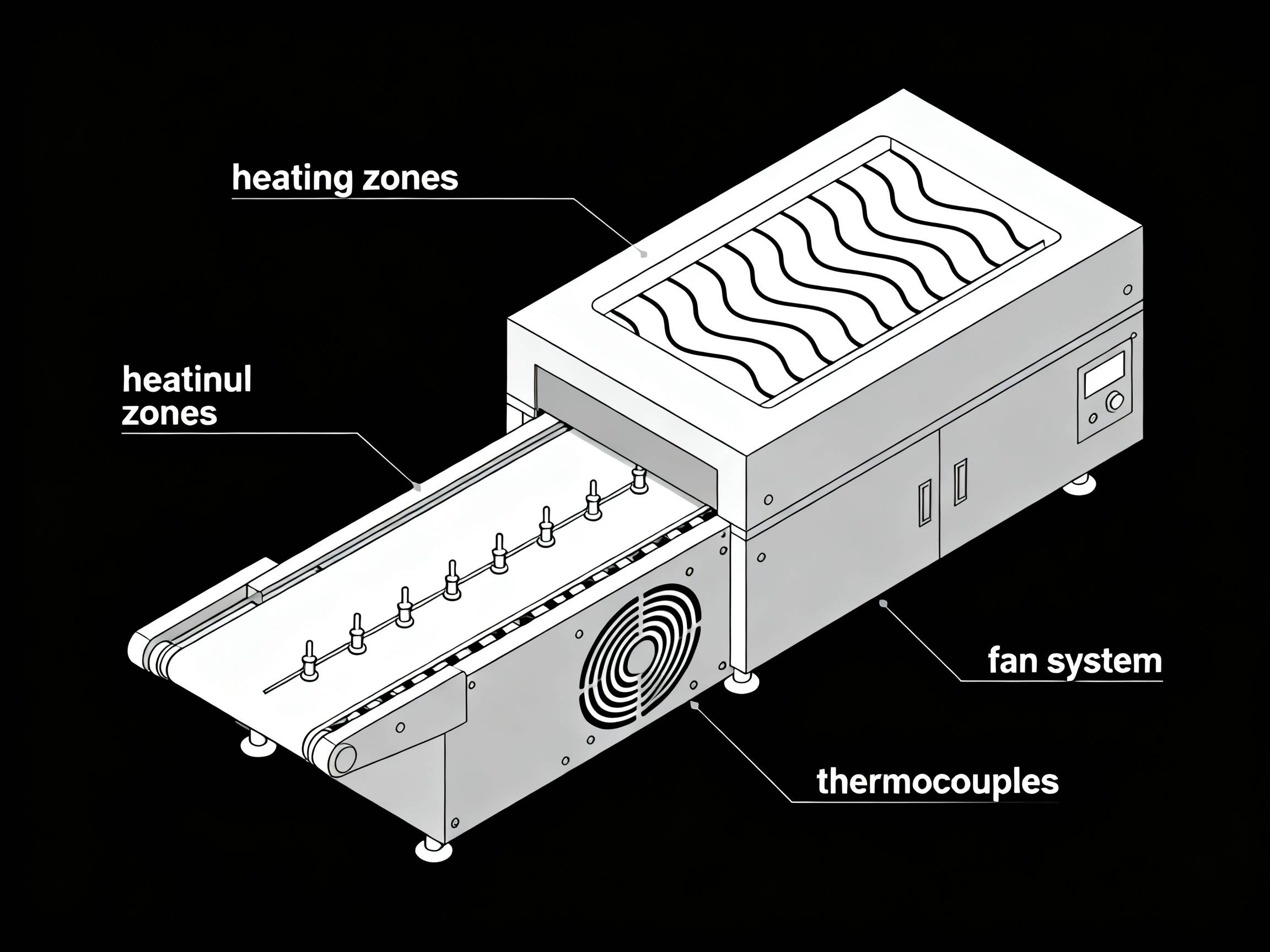
Key parts of a reflow oven include:
- Heating zones: Sections of the oven that control heat application across the preheat, soak, and reflow stages.
- Conveyor system: Moves the PCB steadily through each heating stage to maintain consistent processing times.
- Thermocouples: Measure and regulate temperature inside the oven, ensuring accuracy.
Types of Solder
The type of solder you choose also impacts the process. Lead-based solders were widely used in the past; however, stricter environmental regulations now favor lead-free alternatives. Lead-free solder typically has higher melting points, which requires precise thermal profiling to avoid component damage. Popular lead-free solder options include tin-silver-copper (SAC) alloys.
Choosing the right solder depends on your application. For instance, automotive and aerospace industries often prioritize lead-free for durability and environmental compliance, while niche areas may require specialty solders for better conductivity or unique operating conditions.
Knowing how to work with various solder types ensures you can adapt to different project needs, whether you’re building consumer gadgets or industrial equipment.
From Our Experience: Adopting a flexible solder policy allows manufacturers to address both customer demands and environmental compliance seamlessly.
Troubleshooting Challenges in Reflow Ovens
Reflow ovens are great but like any machinery, they have their hiccups. We all know things don’t always go smoothly. That’s where troubleshooting comes in. Let’s get into the common problems like tombstoning and solder balling.
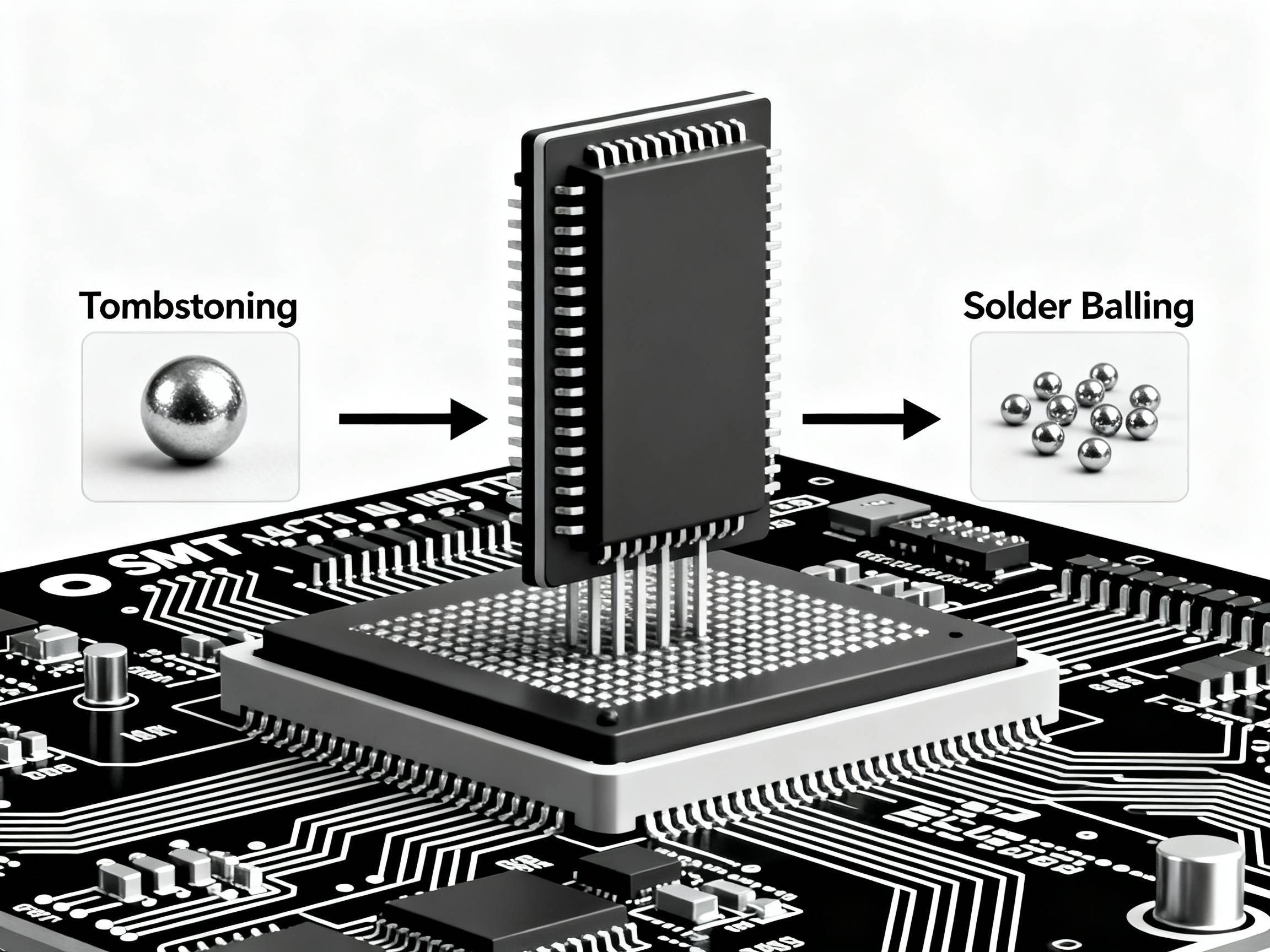
Common Defects: Tombstoning and Solder Balling
Ever notice components standing up on one end like they’re trying to salute? That’s tombstoning. It happens when solder melts unevenly, causing parts to lift. Solder balling is another headache where tiny balls form instead of smooth connections.
Diagnosing Irregularities
Irregular heating profiles can be sneaky culprits. Without the right heat application, defects multiply. Use thermocouples to profile the boards. They help spot where the heat’s not doing its job right.
Practical Tips for Resolving Issues
Don’t stress if things aren’t perfect right away. Adjusting heating profiles can fix many problems. Tune the oven settings to match the solder and PCB materials. Regular maintenance helps too; keep those sensors calibrated and clean off any flux residue.
Expert Tip: Tombstoning can often be solved with detailed adjustments to the heat profiles.
Conclusion: Mastering Reflow Ovens for Advanced Manufacturing
Reflow soldering is essential for modern electronics assembly. The process brings precision and durability. From understanding the basic stages to troubleshooting common issues, manufacturers have the tools to optimize performance. As an expert in this field with years of hands-on experience, I’ve seen how investing in the right equipment pays off.
In 2026, mastering reflow ovens is not just about using the machines. It’s about understanding the nuances of heat application and solder choice. Manufacturers can leverage these insights to ensure high-quality, efficient production.
Expert’s Insight: Having worked with reflow ovens extensively, I know it’s worth embracing automation for the advanced manufacturing process.
Whether you’re assembling consumer devices or aerospace components, reflow soldering offers reliability and speed. Companies like Sun and Mountain SMT lead the way with innovative solutions designed for precision and efficiency.
Summarizing Critical Points for Effective Reflow Soldering
Mastering reflow soldering means understanding the entire oven operation—from selecting materials to troubleshooting issues. Successful soldering involves carefully managing heating profiles and selecting the right solder for the job. The precision of each connection depends on these details, and they play a huge part in the final product’s quality.
Want to reduce manual errors and improve scalability? Automation is your friend. Automated SMT reflow ovens help maintain consistency and increase throughput while minimizing human intervention.
For more knowledge on reflow soldering, dive into industry-specific resources, technical documentation, and equipment manuals. Staying informed helps you get the best out of every machine.
Leveraging Automation and Best Practices
Embracing automation in SMT processes sets you up for success. By leveraging technology, manufacturers can ensure high precision with reduced manual inputs. Automated systems enhance efficiency, allowing you to scale operations without compromising quality.
Companies that focus on integrating these practices often see improvements not only in production speed but also in product reliability. Sun and Mountain SMT provides cutting-edge solutions that help manufacturers achieve seamless transitions in automation.
Resources and Equipment Upgrades
Looking to upgrade your current setup? Consider consulting with experts like Sun and Mountain SMT. Their offerings, such as precision reflow ovens and conveyor systems, are custom-designed for scaling operations and improving production quality.
Staying ahead in technology ensures adaptability to market demands. Equip your team with the latest tools and training, and you’ll be ready to face any manufacturing challenges.
In 2026, the key to mastering reflow soldering technology lies in collaboration with industry leaders and continuous learning. Keep an eye on innovations and trends to maximize production potential.